Synthflow vs CloudTalk Pricing: Cut Voice Costs 40%
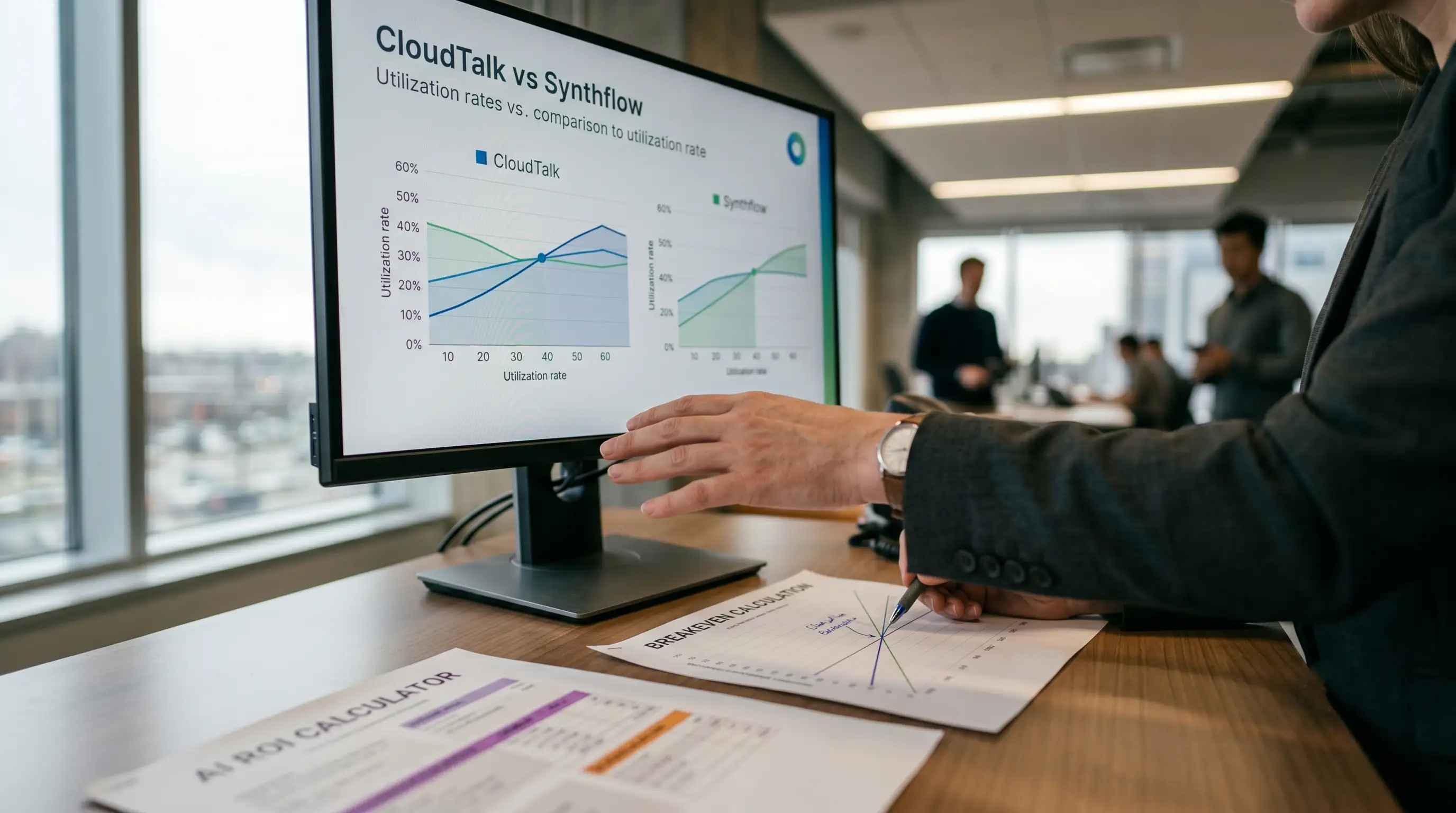
- The Breakeven Crossover: A real worked example at a stated call volume of roughly 20,000 minutes per month reveals the exact financial crossover point between the two billing structures.
- Seat-to-Minute Ratios: CloudTalk bills primarily per seat while charging separately for AI capabilities, whereas Synthflow relies heavily on usage-based, per-minute consumption.
- Hidden Overage Hazards: Failing to accurately cap per-minute consumption on high-volume 24/7 inbound queues can rapidly inflate monthly operational costs.
- Business Case Reality: Projecting your accurate monthly bill requires forecasting human escalation constraints alongside automated AI handling speeds.
Choosing the ultimate configuration from the best AI voice agents for enterprise requires rigorous financial modeling, not just a subjective feature review.
Transitioning away from a legacy telephony setup often obscures the actual recurring expenses associated with modern conversational AI.
Without mathematically mapping exact call minutes against fixed seat licenses, procurement teams routinely authorize software investments that actively drain contact center profitability.
Find the cheaper tier for your volume, then run the ROI numbers.
Per-Minute vs. Per-Seat Pricing Models
The most expensive mistake a contact center leader makes is misaligning their platform's pricing structure with their actual caller behavior.
Synthflow utilizes a highly accessible, usage-based model that bills organizations by the minute.
This frictionless entry point is highly attractive for agencies or operations with unpredictable, highly variable seasonal volume.
CloudTalk builds its commercial foundation on fixed per-seat licenses. It guarantees a highly predictable baseline cost for established, stable sales and support teams functioning on set schedules.
However, CloudTalk treats advanced conversational intelligence as a separate line item.
You must calculate the fixed seat overhead alongside the variable cost of the AI minutes you intend to consume.
The 20,000-Minute Crossover Point
Comparing vendor-quoted list prices is a futile exercise. The true cost of conversational AI only emerges when you map out a real worked example at a stated call volume.
At lower utilization rates, Synthflow’s strict per-minute billing typically dominates the cost-efficiency metrics.
You only pay for the exact seconds the AI agent actively handles a customer query.
As your operation scales toward 20,000 minutes per month, the financial dynamics invert.
The compounding per-minute fees of Synthflow will eventually eclipse the combined cost of CloudTalk's base seats plus its AI allocation.
Before committing, it is imperative to deeply understand the broader financial implications of your CCaaS choice.
Hidden Usage Fees and AI Minute Overages
A low entry price frequently acts as a Trojan horse for crippling overage penalties.
Usage-based platforms like Synthflow scale seamlessly, but without aggressive rate-limiting or tightly defined call flows, conversational agents can rack up extraordinary costs.
Long-winded callers directly increase your monthly invoice.
CloudTalk provides a degree of structural safety through its licensed seats.
However, if your AI call handling spikes dramatically, you must monitor your dedicated AI minute allocation to avoid unforeseen overage brackets.
If you are expanding globally, always inspect the fine print regarding international telephony tariffs.
Surcharges for premium numbers or cross-border connectivity can easily bypass your projected software budget.
The 24/7 Inbound Line: Which Bill Runs Cheaper?
An "always-on" 24/7 inbound support line represents the ultimate stress test for any vendor's pricing model.
For an inbound queue characterized by short, highly transactional queries during off-hours, a per-minute solution often provides the most capital-efficient coverage.
For continuous, high-volume inbound environments where interactions are lengthy and complex, fixed-seat models with bulk AI minutes offer superior cost containment.
Teams evaluating CloudTalk should also cross-reference alternative seat-based competitors to ensure baseline licensing costs remain competitive within their specific market segment.
Conclusion
Determining whether Synthflow or CloudTalk offers the superior pricing model requires completely abandoning generic marketing claims.
You must aggressively model your anticipated usage, identifying exactly where your per-minute costs will eventually intersect with fixed seat licenses.
Never guess your volume. Run the precise operational numbers and secure your budget before locking into a long-term commercial agreement.

Frequently Asked Questions (FAQ)
Synthflow is generally cheaper for low-volume users or highly variable campaigns due to its pay-as-you-go framework. However, CloudTalk becomes significantly cheaper at enterprise scale when fixed seat pricing offsets the escalating costs of pure per-minute billing models.
Synthflow charges purely based on active conversational usage, meaning you pay zero overhead for idle capacity. CloudTalk requires a flat monthly fee per user seat to access the platform, providing predictable base costs regardless of how many standard calls are handled.
The true cost per AI voice minute fluctuates based on the underlying architecture. While base platform rates vary, organizations must actively factor in supplementary telephony tariffs, essential CRM integration taxes, and any necessary language model processing fees to calculate the final per-minute expenditure.
Synthflow is typically the cheaper option at lower operational volumes. Specifically, organizations consuming well below the 20,000-minute per month threshold generally find usage-based billing more economical than absorbing the fixed monthly overhead associated with enterprise per-seat licensing.
Yes, both billing structures contain potential hidden costs. Pure per-minute models risk massive inflation if calls run exceptionally long. Seat-based platforms frequently restrict automated minutes, triggering expensive penalty tiers if your AI agent exceeds its strict monthly conversational allocation.
CloudTalk fundamentally operates on a per-seat subscription model but typically structures its advanced conversational AI capabilities as separate add-on packages. This means teams must pay the base user license and then purchase dedicated AI minutes independently to leverage automated agent features.
For low-frequency, after-hours 24/7 inbound coverage, per-minute platforms often run cheaper since you only pay for actual engagement. However, for continuous, high-volume 24/7 operations, fixed-seat models with bundled automated allowances drastically reduce the financial risk of runaway minute accumulation.
The absolute cheapest enterprise plan depends entirely on your architectural requirements. Bare-metal, open-source infrastructure is the cheapest on paper but carries immense maintenance taxes. Commercially, identifying the cheapest option requires directly mapping your projected call duration against vendor volume discount tiers.
Yes, both vendors aggressively incentivize long-term commitments. CloudTalk frequently offers standard percentage discounts for executing annual, upfront per-seat contracts. Usage-based platforms routinely negotiate custom volume tiers, drastically lowering the raw per-minute processing rate if you commit to massive monthly utilization.
To accurately forecast your monthly bill, you must isolate your average call handle time and multiply it by your total anticipated conversational volume. Next, factor in your precise human escalation rate, adding the cost of live agent seats required to resolve uncontained calls.