« Back to Hub: The Building for Bharat Tech Stack
ONDC & Embedded Finance: The Product Leader’s Guide to Unbundling E-commerce
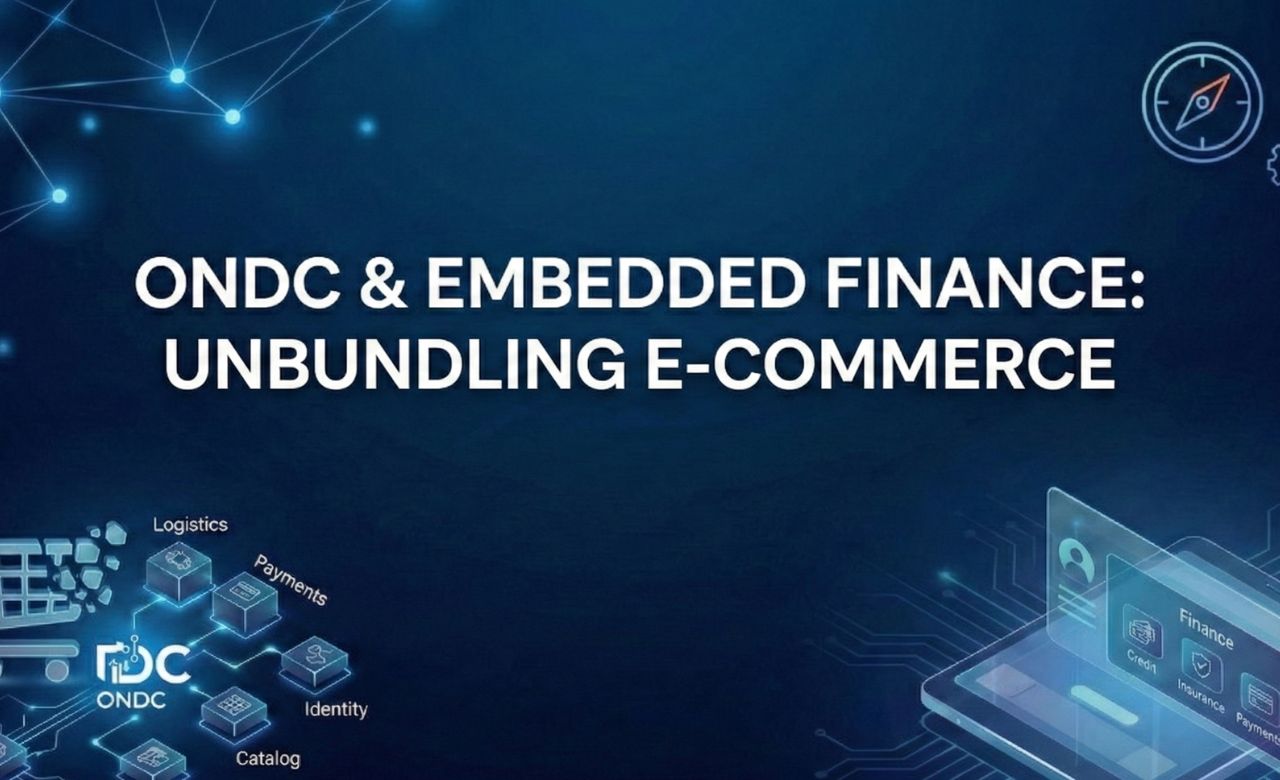
The "UPI Moment" for Commerce
For the last decade, Indian e-commerce was a "Walled Garden" game. You either sold on Amazon/Flipkart, or you spent millions building your own traffic. That era is ending.
ONDC (Open Network for Digital Commerce) is doing to e-commerce what UPI did to payments: unbundling the value chain. For Product Leaders, this isn't just a policy shift; it's an architectural overhaul.
It allows you to build a Buyer App (without owning inventory) or a Seller App (without spending on customer acquisition). Combined with the Account Aggregator (AA) framework and Embedded Finance APIs, you can now build "Super Apps" for Bharat that handle discovery, credit, and logistics via APIs.
This guide breaks down the tech stack, the integration costs, and the "Buy vs. Build" decisions you need to make.
Section 1: The ONDC Architecture Strategy
Network Participant vs. Platform Model
To build on ONDC, you must choose your role. Unlike a traditional platform where you own both sides, ONDC splits the stack.
The Buyer App (The Traffic Play): You focus on acquiring users (e.g., Paytm, PhonePe). Your goal is to provide a seamless interface for users to search the open network.
Tech Stack Challenge: Handling high-concurrency search requests and filtering spam results.
Key API: ONDC Gateway & Beckn Protocol.
The Seller App (The Inventory Play): You digitize merchants (e.g., Magicpin, Shopify). Your goal is to broadcast inventory to the network.
Tech Stack Challenge: Real-time inventory syncing to prevent order cancellations.
The Technology Service Provider (TSP): You don't own users or inventory; you provide the ONDC bridge software to help others connect.
Technical Note: Building an ONDC buyer app from scratch requires robust cloud infrastructure. You will need auto-scaling serverless cloud costs management (AWS Lambda/Google Cloud Run) because ONDC broadcast searches can spike your server load unpredictably.
The "Digital Saathi" Model in ONDC
Technology alone cannot solve the initial trust deficit in rural markets. When scaling B2B networks—especially in rural FMCG supply chains—product managers are discovering that a purely digital onboarding process often leads to high drop-off rates.
Enter the Digital Saathi model. This strategy introduces local, trusted human facilitators to seamlessly bridge the app-onboarding gap. Instead of forcing a Kirana store owner to independently navigate complex B2B buyer software, the Digital Saathi guides them through their first digital interactions. They provide hands-on assistance, helping rural merchants understand the ONDC ordering ecosystem and establishing crucial initial trust.
Once this initial trust is established through human intervention, the ongoing re-order rate becomes highly automated and self-sustaining, driving genuine financial inclusion and maximizing long-term retention across Tier-3 markets.
Section 2: The Integration Decision: Buy vs. Build
Choosing the Best ONDC Bridge Software in India
For most startups, building a direct integration to the ONDC registry is resource-heavy. Product leaders face a classic "Buy vs. Build" choice.
| Feature | Custom Build (In-House) | Using an ONDC Bridge (SaaS/TSP) |
|---|---|---|
| Time to Market | 6-9 Months | 2-4 Weeks |
| Upfront Cost | High (Engineering Salaries) | Low (Setup Fee) |
| Maintenance | High (Protocol updates are frequent) | Low (Managed by Vendor) |
| Control | Full control over UX and Latency | Limited by Vendor API limits |
| Best For | "Enterprise Giants (Banks, Telcos)" | Startups & SMEs |
Commercial Insight: The ecosystem has rapidly evolved beyond basic API bridges. If you choose to buy, evaluate specialized, officially registered Technology Service Providers (TSPs) that now offer advanced voice-assisted integration tools alongside standard ONDC seller app integration APIs. These modern TSPs reduce integration time from months to weeks and allow your app to natively support voice-first product searches, which is critical for driving Tier-3 adoption.
Section 3: The Money Layer (Embedded Finance)
Leveraging Account Aggregators & Lending APIs
Tier-3 users often lack CIBIL scores. To monetize them, you need Embedded Lending APIs that use alternative data.
The Account Aggregator (AA) Framework: Instead of asking for a salary slip, your app can request consent to fetch bank statement data directly via AA APIs (e.g., Setu, Anumati).
Use Case: Credit risk scoring API for new-to-credit users. Analyze cash flow patterns (UPI ins/outs) to offer micro-loans.
Payments & Collections: For subscription models (e.g., localized OTT or SaaS), integration of UPI Autopay is critical.
Recommendation: Use a white label payment gateway for Bharat that supports vernacular checkout pages and handles flakey 2G/3G connections gracefully.
Cost Analysis: Fintech API integration costs in India have dropped. Identity verification (KYC) creates friction. Use the best KYC API for low bandwidth areas (optimized for video KYC on cheap smartphones) to reduce drop-offs.
Section 4: The Physical Layer (Logistics)
Supply Chain Automation for Non-Metro Cities
Selling is easy; delivering to "Pin Code 845401" is hard. In the ONDC model, logistics is also unbundled.
Logistics-as-a-Service: You don't need your own fleet. You integrate logistics APIs for Tier-3 delivery (e.g., Delhivery, Shadowfax, Shiprocket) that plug directly into the ONDC protocol.
Hyperlocal Optimization: For grocery/food, use supply chain automation software that supports "hub-and-spoke" models. This is critical for keeping unit economics green in areas with low order density.
Section 5: Trust & Redressal
Handling Disputes in an Open Network
In a centralized model (Amazon), you call Amazon support. In an open network, who do you call?
ODR (Online Dispute Resolution): Product managers must integrate the ONDC grievance redressal mechanism API. This allows a buyer to raise a ticket that is automatically routed to the correct seller app and logistics provider without manual intervention.
FAQ: ONDC & Fintech Architecture
Q: What are the server costs for an ONDC App?
A: It depends on volume, but expect higher "Read" costs due to search broadcasting. Using Serverless cloud architectures (AWS Lambda/Azure Functions) is recommended to handle the "bursty" nature of ONDC traffic without paying for idle servers.
Q: Can I use Stripe/Razorpay for ONDC?
A: Yes. Most major gateways act as the "Financial Layer." You will need to configure Recurring payment mandate APIs if you are running a subscription business model on the network.
Q: What is the difference between an ONDC Participant and a Platform?
A: A platform controls the rules, the UI, and the data. An ONDC participant connects to a public registry. You own your user experience, but you do not "own" the network.
Q: How do I handle KYC for rural users with poor internet?
A: Use lightweight, AI-driven KYC solutions. Look for vendors offering Offline Aadhar XML verification or low-bandwidth Video KYC to ensure high success rates in Tier-3 regions.

Sources & References
The following are the authentic sources referenced in this guide: