« Back to Pillar Page: Product Leaders Day India
Influence Without Authority: The Stakeholder Playbook
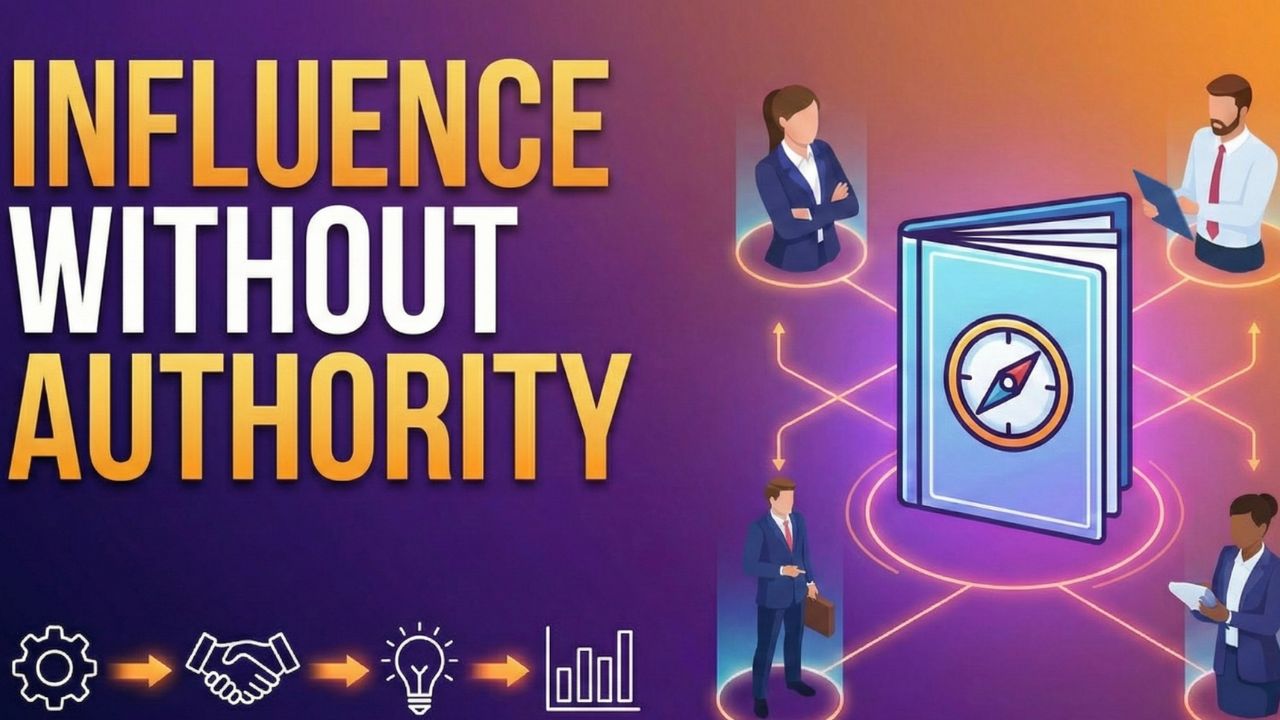
The cliché that a Product Manager is the "CEO of the Product" is dangerous. CEOs can fire people; you cannot. You are the Diplomat of the product.
Your success depends entirely on your ability to convince Engineering, Sales, and Leadership to follow you voluntarily. This playbook covers the psychology of influence and provides the exact scripts you need to move people who don't report to you.
I. The Psychology of Influence
Before jumping into the scripts, we must understand the mechanics. Influence without authority relies on the Trust Equation:
- Credibility: Do you know your stuff?
- Reliability: Do you do what you say you will?
- Intimacy: Do they feel safe with you?
- Self-Orientation: Are you doing this for the user/company, or just for your own ego? (High self-orientation destroys trust).
The following scripts are designed to lower your Self-Orientation and increase Intimacy and Credibility.
II. The Script Vault: Roleplay Scripts
Don't just tell your team to "be empathetic." Use these exact words to navigate critical friction points.
Scenario A: The "No" That Saves You
The Situation: A stakeholder (Marketing or a Founder) wants a new feature added to the current sprint. It’s a bad idea or simply bad timing.
The Trap: Saying "No, we don't have capacity." This sounds like an excuse and invites them to argue about your team's efficiency.
Stakeholder: "We really need this 'Share to TikTok' feature live by Friday for the campaign."
You (The Pivot): "I can see clearly how that would drive engagement for the campaign. The trouble is, if we pull the engineers onto this today, we have to pause the Payment Gateway migration. How would you like us to weigh those trade-offs?"
Why This Works:
- Validation: You acknowledged their goal first ("drive engagement").
- The "How" Question: You didn't say no. You asked them to solve the logic puzzle. You shifted the burden of the decision from your authority to the reality of constraints.
Scenario B: The Engineering Standoff
The Situation: You propose a feature, and the Tech Lead says, "It can't be done," or "That will take three months." You suspect there is a simpler way, but you aren't the coder.
The Trap: Saying "I'm sure it's not that hard," or "Can't you just..." (Engineers hate this).
Engineer: "Refactoring the search bar is a nightmare. The legacy code is spaghetti. It’s a 6-week job."
You (The Investigation): "I understand. I definitely don't want us breaking the legacy code and creating tech debt. Help me understand the specific blocker: is it the visual design of the search bar, or the way it queries the database?"
Engineer: "It's the database query. It's slow."
You (The Bargain): "Okay, that helps. What if we kept the old query logic but just updated the UI skin for now? Would that move us from 6 weeks to 1 week?"
Why This Works:
- Respecting Expertise: You aren't challenging their estimate; you are investigating the scope.
- De-risking: By isolating the variable (UI vs. Database), you empower the engineer to find a solution that fits your timeline without compromising their technical standards.
Scenario C: The Sales Emergency
The Situation: The CRO (Chief Revenue Officer) or VP of Sales comes to you in a panic. A big deal is at risk because the product lacks Feature X. They are emotional and aggressive.
The Trap: Using logic immediately ("That feature isn't on the roadmap"). Logic bounces off high emotion.
CRO: "We are going to lose the Acme Corp deal if we don't have custom reporting! Product is killing my sales numbers!"
You (Tactical Empathy/Labeling): "It sounds like you feel we’re leaving your team exposed in these enterprise conversations."
CRO: "Exactly! I look like an idiot out there."
You: "And it seems like you’re worried this isn't just about Acme Corp, but a trend we're seeing with other leads too?"
CRO: "Yes. It's happened three times this month."
You: "Okay. I can't build custom reporting this week, but let's look at what data Acme Corp specifically needs right now. Is there a manual export we can do for them to save the deal while we scope the full feature?"
Why This Works:
- Labeling: You labeled their emotion ("You feel exposed"). This forces the brain to switch from the Amygdala (fight/flight) to the Prefrontal Cortex (rational thought).
- De-escalation: You cannot negotiate until they feel heard. Once they say "Exactly," the tension drops, and you can problem-solve.
III. Strategic Framework: The "FBI" Model
These scripts are based on the behavioral change stairway model often used in hostage negotiation (popularized by Chris Voss).
- Active Listening: Listen to hear, not to respond.
- Empathy: Validate their pain.
- Rapport: Build a bridge of trust.
- Influence: Now—and only now—can you suggest a change in behavior or direction.
The Golden Rule: Influence is not about winning the argument. It is about aligning the outcome.
When you frame your "No" as a protection of their long-term interests (e.g., "I'm saying no to this feature so the system doesn't crash during your big launch"), you gain allies, not enemies.
Frequently Asked Questions (FAQs)
Q1: What if I use the scripts and they still say "Do it anyway"?
This is a "Disagree and Commit" moment, but you must document the risk. Use a "Risk Memos" approach: "I will instruct the team to proceed with X as requested. However, please note that this guarantees delay of Y. I am noting this here so we are aligned on the consequences." This often makes stakeholders pause and reconsider.
Q2: How do I influence stakeholders who are significantly more senior than me (e.g., C-Suite)?
Senior leaders care about outcomes, not output. Stop talking about "Story points" or "Features." Speak their language: Revenue, Retention, and Risk. Don't say "We can't build this." Say "Building this introduces a risk to our Q3 Retention goal."
Q3: Can these techniques work for introverted Product Managers?
Absolutely. In fact, introverts are often better at this because they are naturally better listeners. "Influence without authority" requires deep listening and observation, which plays to an introvert's strengths. You don't need to be the loudest in the room; you need to be the most prepared.

Sources & Recommended Reading
- Voss, Chris. Never Split the Difference. (The bible of tactical empathy and negotiation).
- Cialdini, Robert. Influence: The Psychology of Persuasion. (Understanding the principles of Reciprocity and Social Proof).
- Stone, Douglas; Patton, Bruce; Heen, Sheila. Difficult Conversations: How to Discuss What Matters Most. (Great for the "Engineering Standoff" scenarios).
- Harvard Business Review. How to Influence People When You Don’t Have Authority. (Foundational article on the "exchange model" of influence).