IDC FutureScape Sovereign AI: 60% Split, 3x Cost by 2028
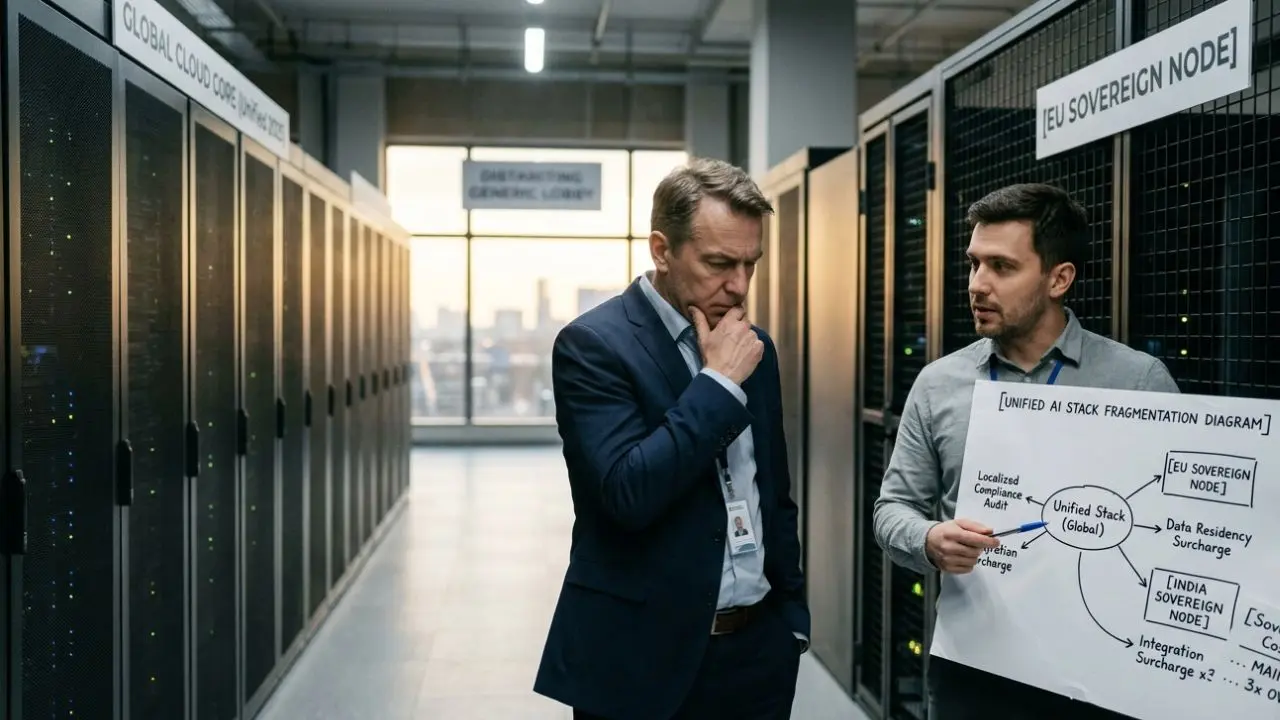
- The Stack Fragmentation Pivot: Global software architectures are fracturing along geopolitical fault lines, ending the era of centralized data oceans.
- The Integration Cost Surcharge: Multi-jurisdictional compliance layers are projected to triple standard software maintenance and integration costs.
- Workload Isolation Demands: High-risk customer interaction data and localized processing systems must be decoupled from generalized pipelines.
- Strategic Cloud Parity: Successful implementation requires a calculated trade-off between localized runtime isolation and global algorithmic efficiency.
The global cloud landscape is undergoing a massive structural division that will fundamentally alter how multinational enterprises purchase, scale, and maintain computational workflows. Research projections highlight that 60% of multinationals will split AI stacks across sovereign zones by 2028, introducing profound architectural complexity. This tectonic shift away from borderless cloud models creates unprecedented challenges for technological operations.
Navigating this hyper-fragmented reality requires a defensive operational blueprint. As detailed in our comprehensive Sovereign AI infrastructure guide 2026, balancing compliance mandates with economic constraints demands a complete rethink of core infrastructure architectures. Enterprises can no longer treat global cloud platforms as unified fabrics without introducing existential regulatory exposure.
Deconstructing the IDC FutureScape 2026 Sovereign AI Prediction
The latest data from global technology analysts reveals a definitive breakdown of borderless IT models. Global firms are pivoting quickly to shield their operational structures from mounting cross-border regulatory interference.
The Operational Reality of the 60% Enterprise AI Stack Split
The IDC FutureScape 2026 AI forecast highlights that 60% of large-scale multinational entities will be legally or operationally compelled to split their data layers. This means model configurations, orchestrators, and vector storage networks will be physically partitioned into isolated jurisdictional zones.
This environment completely invalidates traditional multi-region clustering configurations. Instead, it forces engineering teams to build distinct, air-gapped instances for different regional compliance blocks.
Analyzing the Mechanics of the 3x Integration Cost Forecast
A primary challenge identified within the sovereign AI cost forecast is the projected 3x cost multiplier for integration overhead. This financial penalty stems from duplicating enterprise middleware, maintaining distinct encryption infrastructure, and rewriting context pipelines. Furthermore, data engineers face a steep efficiency tax. They must build separate auditing networks to monitor localized model instances across multiple territories simultaneously.
Technical Impact: The Economics of AI Stack Fragmentation
Splitting an enterprise computing stack introduces deep, systemic friction that impacts everything from physical raw resource footprints to long-term database architectures. The financial impact of AI stack fragmentation is driven heavily by vendor lock-in within sovereign boundaries. When companies can no longer route compute to the lowest-cost international region, they must maintain underutilized capacity inside localized frameworks.
Strategic Workload Mapping: What to Centralize vs. Split
To maintain structural viability amidst these shifts, enterprises must develop objective criteria to isolate specific operational workloads.
Defining Sovereign Zone Boundaries for Regulated Datasets
Enterprise infrastructure planners must perform explicit sovereign zone workload mapping across all operational divisions. High-risk systems—such as customer identity directories, health records, and localized financial transactions—must remain strictly isolated within local borders. These networks must utilize regional execution nodes to ensure zero unauthorized cross-border leakage.
Maintaining Centralized Pipelines for Non-Sovereign Foundational Training
Conversely, general asset classes can remain within centralized cloud networks to preserve cost efficiencies. Core foundational models, non-personal codebases, and anonymized global market trends should be kept in centralized pipelines. This allows companies to maximize hardware efficiency before deploying fine-tuned weights down to regional execution environments.
Industry Analysts Clashing: Gartner vs. IDC Sovereign AI
The technology consulting landscape presents diverging views on how server infrastructure will respond to these rising geopolitical boundaries. While IDC points to an aggressive, costly division of physical architectures, other frameworks suggest a more gradual software-defined evolution. This analytical friction creates confusion for corporate technology strategists seeking a predictable infrastructure path.
To bridge these cross-border data requirements without creating compliance liabilities, architectures must align with verified international frameworks. This includes anchoring multi-jurisdictional pipelines within a defined India's GCC performance global benchmarking framework to ensure that local processing nodes map cleanly to global execution environments.

Frequently Asked Questions (FAQ)
What is the IDC FutureScape 2026 prediction for sovereign AI?
The IDC FutureScape 2026 forecast states that 60% of multinational organizations will be forced to split their core AI stacks across sovereign zones by 2028. This shift is driven by strict data protection mandates, changing national security regulations, and regional data residency requirements worldwide.
Why does IDC forecast a 3x integration cost increase by 2028?
IDC projects a threefold increase in integration costs due to the operational complexities of running separate infrastructure environments. This includes duplicating middleware, managing separate regional encryption keys, building custom auditing pipelines, and overcoming the loss of global cloud scale efficiencies.
Which industries will be hit hardest by AI stack fragmentation?
Highly regulated industries will experience the most friction. Banking, financial services, insurance, healthcare, and defense sectors face intense regulatory scrutiny, requiring complete data residency isolation and localized model execution frameworks to remain compliant.
How accurate have past IDC FutureScape AI predictions been?
Past IDC FutureScape predictions have reliably mapped major enterprise shifts, particularly regarding cloud adoption timelines and containerized application deployments. Their multi-year models reflect deep tracking of global vendor capabilities and shifting regulatory constraints.
What does 'AI stack split' mean operationally for a global enterprise?
Operationally, an AI stack split requires decoupling data pipelines from a centralized repository. An enterprise must run distinct instances of models, vector databases, and user prompt flows within specific geographic regions, eliminating unified cross-border data processing streams.
How should CFOs budget for sovereign AI integration overhead?
CFOs must allocate budget for increased regional hosting fees, software licensing costs for separate environments, and specialized engineering talent. They must prepare for a move away from variable cloud pricing toward higher fixed costs for sovereign infrastructure.
Which sovereign zones are forecast to grow fastest by IDC?
The European Union and India are projected to see the fastest growth in sovereign cloud deployments. This growth is directly accelerated by strict legislative mandates, specifically the enforcement of the EU AI Act and India’s Digital Personal Data Protection Act (DPDPA).
How does IDC's view compare to Gartner's on sovereign AI?
IDC focuses on the physical splitting of infrastructure and the resulting integration cost penalties. Conversely, Gartner emphasizes a software-defined approach, predicting that abstraction layers and hybrid configurations will help mitigate some of the physical fragmentation costs over time.
What is the IDC FutureScape methodology for AI predictions?
The methodology combines comprehensive global enterprise IT spend tracking, deep interviews with technology buyers, and structural vendor capability reviews. This data is synthesized with macro-economic trends and international regulatory timelines to build multi-year market forecasts.
Which workloads should remain centralized vs split per IDC?
Generalized foundational model training, non-sensitive algorithmic testing, and anonymized operational metadata can remain centralized. However, any systems processing customer personal data, localized transactional records, or high-risk decision workloads must be split into regional sovereign zones.