PSPBM Skills: Build a Product Backlog People Actually Trust
What You'll Learn
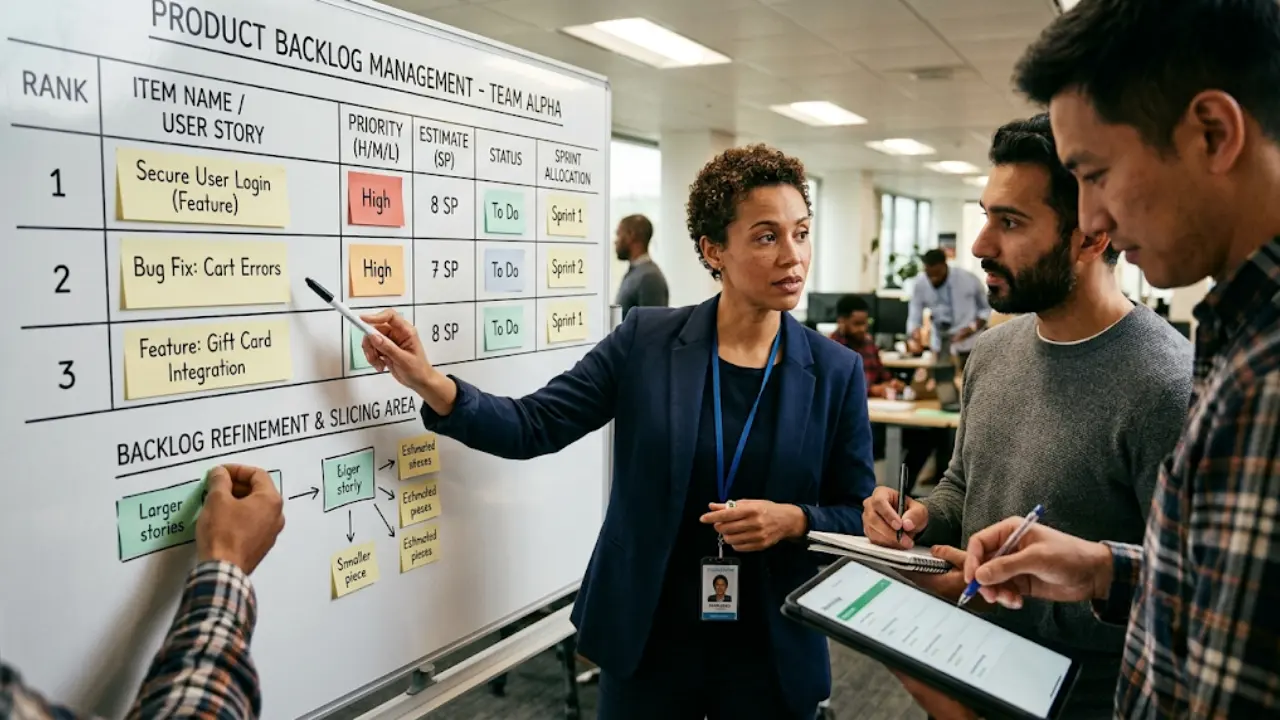
- Practical techniques to create, refine and order a Product Backlog that expresses your Product Goal.
- How to decompose and slice Product Backlog items so every item is small, valuable and understandable.
- How to interpret stakeholder needs and capture them as Product Backlog items instead of transcribing requests.
- How simplicity cures a complicated backlog — and how transparency changes the conversations around it.
- Exactly what the official PSPBM Skills certification covers, what it costs, and how to prepare.
Your Backlog Is Not a List. It Is a Decision Record.
Open the Product Backlog of almost any team and you will find the same thing: a few hundred items, most of them stale, several of them duplicates, a handful nobody can explain, and an ordering that reflects whoever asked most recently rather than what would create the most value. It is not a backlog. It is an archive of every request that was ever made and never refused.
The Scrum Guide is unambiguous about what it should be instead — an emergent, ordered list of what is needed to improve the product, and the single source of work undertaken by the Scrum Team. Every word in that sentence is doing work. Emergent, so it changes constantly. Ordered, so someone has made a judgment. Single source, so nothing arrives from the side. When a backlog stops matching that description, the cost is not untidiness. The cost is that nobody outside the team can see what the product is becoming.
"A backlog people don't trust gets bypassed. And once it gets bypassed, you're not running a product — you're processing requests."
Professional Scrum Product Backlog Management Skills (PSPBMS) is a one-day Scrum.org class built for exactly this problem. It is not a class about what a Product Backlog is. It is a day spent working on one — adding, deleting, updating, ordering, slicing, and explaining, until the backlog is something you would be comfortable putting on a screen in front of your CFO.
Refinement Is a Skill, Not a Recurring Meeting
Most teams treat refinement as a calendar entry. An hour every Wednesday where the Product Owner reads items aloud and developers nod. Nothing gets smaller, nothing gets clearer, and the same item comes back next week with an extra sentence bolted onto it.
Refinement is actually a set of learnable techniques, and the reason teams do it badly is that nobody ever taught them the moves. How do you split an item that is genuinely large without splitting it into meaningless technical fragments? How do you tell the difference between an item that is too big and an item that is simply badly understood? When is a spike honest, and when is it a way of avoiding a decision?
Simplicity as a Cure
One of the strongest ideas in this class is that complexity in a Product Backlog is usually self-inflicted. Teams add fields, hierarchies, tags, statuses and epics-within-epics, then complain that the tooling is heavy. In the class you take a genuinely complicated backlog and make it simple — and then examine what you lost, which is almost always nothing except the illusion of control.
The Backlog Skills You Will Practise
This is a skills class. Every item below is something you will do with your own hands during the day, on a shared collaboration board, with feedback:
- Capturing customer and stakeholder needs. Take raw, messy input — a complaint, a demand, a support ticket, a hallway conversation — and turn it into a Product Backlog item that states a need rather than a solution.
- Decomposing and slicing. Break large items into smaller ones that are still independently valuable, using slicing patterns that keep each piece meaningful to a user instead of splitting by technical layer.
- Ordering for value. Move beyond priority labels to a genuine order, and be able to explain why item seven sits above item eight when someone senior asks.
- Connecting work to the Product Goal. Make the line from Product Goal to Sprint Goal to Product Backlog item visible, so the backlog reads as a strategy rather than a queue.
- Making the backlog transparent. Formats, granularity, and language choices that let stakeholders read the backlog without a translator sitting next to them.
- Managing stakeholder relationships. Map who your stakeholders actually are, what each one needs to see, and how to say no to a request without damaging the relationship.
- Using empiricism as a competitive advantage. Treat backlog items as things you learn from, not just things you complete — and let evidence change the order.
Opaque Backlog vs. Transparent Backlog
The gap this class closes is easiest to see side by side. The left column is what most teams live with. The right column is what you will practise building.
| Dimension | Opaque Backlog | Transparent Backlog (PSPBM Skills) |
|---|---|---|
| What items describe | Solutions someone requested | Needs and outcomes worth pursuing |
| Ordering logic | Recency, seniority, or a priority field | An explicit, defensible value judgment |
| Item size | Whatever size it arrived at | Sliced to be small and still valuable |
| Stakeholder access | Needs a Product Owner to interpret it | Readable directly, without translation |
| Relationship to strategy | Disconnected from the Product Goal | Every item traceable to the Product Goal |
| Response to new evidence | Items accumulate; nothing is removed | Order changes; items are deleted freely |
Stakeholders: Interpret Needs, Don't Transcribe Requests
Half of Product Backlog management happens outside the backlog. It happens in the conversation where a stakeholder says "we need a dashboard" and you have to work out what they are actually trying to see, decide, or prove — before it becomes an item.
Teams that skip that step end up with a backlog that is a faithful transcript of everything anyone ever asked for. It is transparent in the worst possible way: perfectly visible, and completely uninformative. The class spends real time on the stakeholder side of the job — identifying who matters, understanding what each group needs, communicating progress in terms they care about, and handling the moment where the answer has to be no.
This is the part of the job that rarely appears in a certification syllabus and constantly appears in your calendar. It is also the reason Scrum Masters who coach Product Owners get real value from this class even though they never touch the backlog themselves.
AI Makes Bad Backlogs Faster
You can now paste a transcript into an AI tool and get forty Product Backlog items back in thirty seconds. They will be well-formatted, consistently phrased, and confident. They will also include things no customer asked for, phrased in a way that makes them sound validated.
That is the new failure mode, and it is worth naming: AI removes the friction that used to limit how much rubbish could enter a backlog. When generating items becomes free, the discipline of deleting them becomes the skill that matters.
As the trainer of Scrum.org's Professional Scrum Master – AI Essentials (PSM-AI) and Professional Scrum Product Owner – AI Essentials (PSPO-AI), I bring this lens directly into the class: where AI genuinely accelerates backlog work — clustering feedback at scale, drafting first-pass slices, spotting duplicates and contradictions — and where ordering, value judgment, and stakeholder trust remain irreducibly human.
Is the PSPBM Skills Course Right for You?
Assess your readiness. Check all boxes where your answer is YES:
- Has your Product Backlog grown into something nobody can read end to end?
- Does refinement happen every week without items actually getting smaller or clearer?
- Do you struggle to explain why one item sits above another when challenged?
- Do stakeholders bring work to your team through side channels instead of the backlog?
- Do you want an industry-recognised Scrum.org credential in Product Backlog management?
If you checked ANY box, you belong in our next PSPBM Skills cohort.
Course Overview
Professional Scrum Product Backlog Management Skills™ is a Scrum.org class designed to help Scrum practitioners improve their ability to manage every aspect of the Product Backlog and the stakeholder communication around it. You learn techniques and methods to manage a backlog that clearly expresses the Product Goal and brings transparency to what is most valuable for the Scrum Team to work on.
Students get hands-on experience with refinement techniques such as decomposing and slicing Product Backlog items, while learning how simplicity can cure a complicated and complex Product Backlog. You will connect the Product Goals you are investing in to the work actually being done, so you can show that value is being delivered — and understand how to manage the relationships with the stakeholders involved.
Who Should Attend
The class is built for anyone who refines, describes, orders or communicates Product Backlog items:
- Product Owners looking for practical ways to manage their stakeholders and their backlog.
- Professionals new to product ownership who want the essential Product Owner practices.
- Scrum Masters who want to be a genuinely useful coach to their Product Owner.
- Product Managers and Business Analysts looking to sharpen their backlog management skills.
- Anyone working on refining, describing or communicating Product Backlog items.
Quick Class Facts
Upcoming Options: Friday, 16th Oct 2026, 10:30 AM – 5:00 PM IST
Duration: 1 Day (Live Virtual)
Delivery: Highly interactive Zoom class with collaboration boards
Trainer: Sanjay Saini, Professional Scrum Trainer (PST)
Delivered in person, this course generally runs over one day. As a Live Virtual Class it may be split into shorter days. A self-paced version is also available from Scrum.org and takes approximately five hours to complete.
Course Learning Outcomes
By the end of the day you will be able to:
- Implement practical techniques to create, refine and order the Product Backlog.
- Explain techniques to communicate effectively with stakeholders.
- Interpret stakeholder needs rather than recording stakeholder requests.
- Capture stakeholder needs as Product Backlog items that stand up to scrutiny.
- Discuss better ways to make the Product Backlog more transparent.
- Describe empiricism as a competitive advantage, not a ceremony.
Focus Areas Covered
The PSPBM Skills assessment draws its questions from the Focus Areas defined in the Professional Scrum Competencies that concern Product Backlog management:
| Competency | Focus Areas |
|---|---|
| Understanding and Applying the Scrum Framework | The Product Backlog |
| Managing Products with Agility | Product Backlog Management Stakeholders |
You can view the full competency mapping across this and other Scrum.org classes.
PSPBM Skills Certification Details
| Assessment fee | USD 200 (included free with this class) |
| Passing score | 85% |
| Time limit | 30 minutes |
| Number of questions | 20 |
| Format | Multiple choice |
| Language | English |
| Digital credential | Free Credly badge included |
| Password validity | No expiry date, valid for one attempt only |
| Renewal | Lifetime certification — no annual renewal fee |
Training Investment
| Participant Location | Investment Fee |
|---|---|
| Indian Participants | INR 13,990 + 18% GST |
| International Participants | $295 USD |
What's Included in Your Registration?
- Certification: Password to attempt the official Scrum.org PSPBM Skills assessment — plus a FREE second attempt if you attempt within 14 days and score below 85%.
- Toolkit: The slicing patterns, refinement checklists, stakeholder maps and backlog transparency templates used in class, ready to use with your team the next morning.
- Resources: A curated reading path on backlog management, story slicing and stakeholder communication.
- Networking: Access to the Product Leaders Day India community and post-class support for your real backlog questions.
Frequently Asked Questions (FAQ)
No. There are no formal prerequisites for either the class or the assessment. A strong understanding of Scrum is foundational to performing well on the certification, so having earned PSM I or PSPO I is advantageous — but it is not required.
PSPO I covers the full Product Owner accountability — product vision, value, and the Product Owner stances. PSPBM Skills goes narrow and deep on one part of that job: managing the Product Backlog itself. It is a skills class about refining, decomposing, slicing, ordering and making the backlog transparent, plus the stakeholder communication that surrounds it.
It is 20 multiple choice questions in English, with a 30 minute time limit and a passing score of 85%. Bought separately from Scrum.org it costs $200 USD; it is included with this class. A free Credly digital credential comes with it, the certification is lifetime with no renewal fee, and each password has no expiry date but is valid for a single attempt.
No. Attendance is not a prerequisite, and anyone can buy the assessment password directly from Scrum.org. Attending a skills course is strongly recommended, because the assessment tests how techniques are applied rather than what they are called — and the class is where you practise applying them.
It is a skills-building class, so the majority of the day is practice. You work in small groups on a shared collaboration board — decomposing and slicing real Product Backlog items, turning raw stakeholder input into backlog items, and reworking a complicated backlog into a simple, transparent one.
AI can cluster feedback, draft candidate items and suggest slices in seconds — which makes it very easy to generate a large, confident-looking backlog full of things nobody asked for. As the trainer of Scrum.org's PSM-AI and PSPO-AI courses, Sanjay shows where AI genuinely speeds up refinement and where ordering, value judgment and stakeholder trust stay human work.
Not sure the item belongs in the backlog at all?
PSPBM Skills makes your backlog clear and ordered. Professional Product Discovery and Validation (PPDV) is the class that helps you decide what deserves to be in it — framing problems, running experiments, and validating assumptions before the item is ever written.
Continue Your Product Learning
Explore more hands-on workshops for product professionals:
Product Owner – Advanced (PSPO-A)
For experienced Product Owners. Sharpen decision-making under uncertainty and learn to defend product value with your own product.
AI for Product Owners (PSPO-AI)
Harness GenAI across every Product Owner stance — the Orchestrator mindset, automated backlogs, and faster discovery.
All Product Trainings
Browse the full catalogue of product and agile workshops from AgileWoW.
Final Takeaway: Transparency Is Not a Reporting Problem
Teams usually try to solve backlog transparency with tooling — a better board, a new field, a nicer roadmap view. It rarely works, because the problem was never the display layer. It was that the items themselves were too big, too vague, or written as solutions nobody had validated.
Fix the items and the ordering, and transparency stops being something you produce for stakeholders and becomes something they can just see. That is a one-day skill set, and it pays back the first time someone senior asks why item seven is above item eight — and you have an answer.