This blog is part of Agentic AI Product Management .
B2A (Business-to-Agent): Designing for Non-Human Users
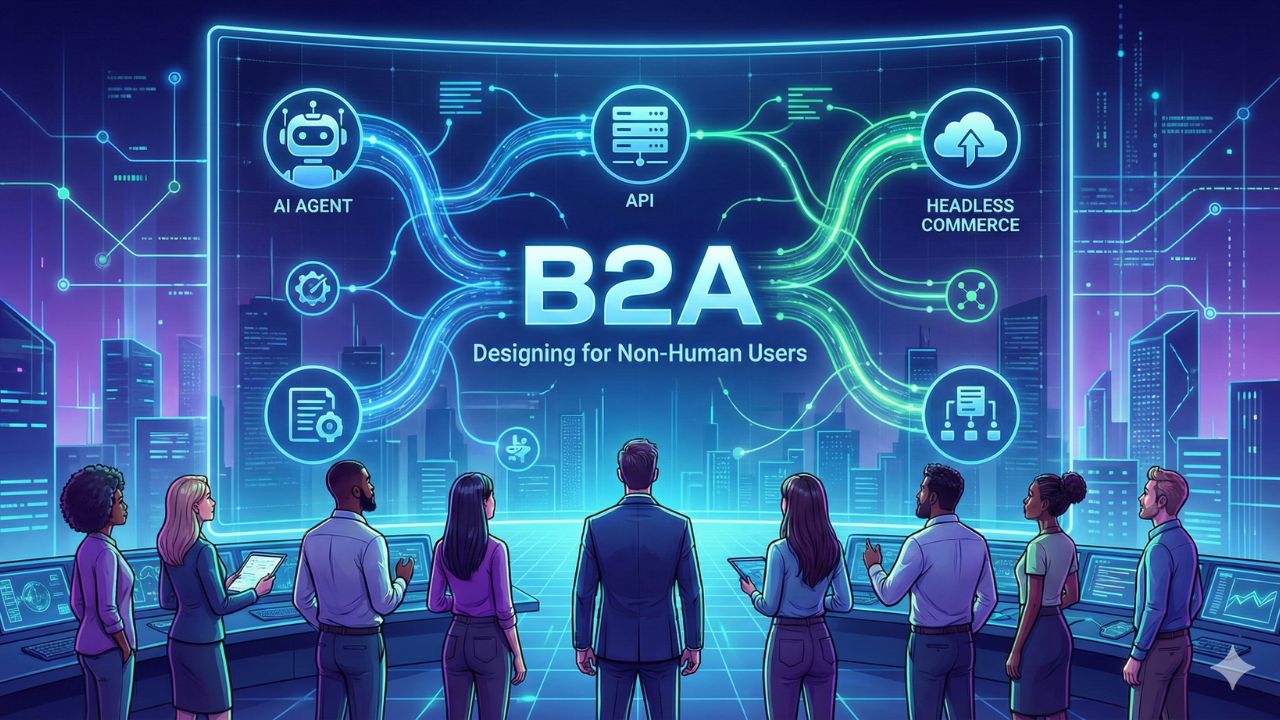
The era of "optimizing for eyeballs" is ending. We are entering the era of "optimizing for API calls." Your next power user isn't a human scrolling through a webpage; it is a customer's personal AI agent booking flights, buying software, or restocking inventory on their behalf.
This concept, known as B2A (Business-to-Agent), requires a fundamental shift in product strategy: making your product "machine-readable" for the autonomous economy of 2026. While traditional UX focuses on emotion and visual hierarchy, B2A focuses on logic, structured data, and permission protocols.
The Rise of the Machine Customer
Target Audience: Product Designers, API Product Managers, Technical PMs.
The premise is simple yet disruptive: Future transactions will be negotiated and executed by AI agents. By 2026, it is estimated that a significant percentage of routine digital transactions—renewing subscriptions, booking travel, or purchasing consumables—will be automated. If your product's value is locked behind a beautiful Graphical User Interface (GUI) but is inaccessible via API, you are effectively invisible to this new class of "Agent Customers".
The Shift from Emotional to Rational Buying
In B2C, we design for impulse and emotion. We use colors like red for urgency and blue for trust. However, AI agents do not "feel" trust; they calculate it.
- Humans: Influenced by social proof, aesthetics, and brand storytelling.
- Agents: Influenced by latency, API uptime, data structure (JSON/XML), and verifiable security protocols.
For the Product Manager, this means the "Customer Journey Map" must now include the "Agent Execution Flow." Where a human might tolerate a broken link or a confusing layout by guessing, an agent will simply error out and move to a competitor with better documentation.
Key Content: UI < API
In the B2A world, your User Interface (UI) matters significantly less than your API documentation. The battleground for customer acquisition is shifting from the browser window to the terminal console.
Why "Machine-Readability" is the New UX
Human users care about colors, emotional copy, and intuitive layouts. AI agents care about technical precision:
- Latency & Efficiency: How fast can they retrieve data? Agents operate in milliseconds; a slow API is a lost sale.
- Structure & Semantics: Is the data structured (JSON, Schema.org) or trapped in unstructured HTML? Agents struggle to "scrape" visual websites reliably; they thrive on structured feeds.
- Permissions & Auth: Can the agent autonomously execute a "POST" request to buy? Traditional 2FA (Two-Factor Authentication) designed for humans often breaks autonomous agents. We need Oauth2 "Client Credentials" flows that allow authorized machines to act on behalf of users.
Key Concept: Your API Documentation is your new Landing Page. In 2026, an agent will 'read' your API docs to determine if your product can solve its user's problem. If the docs are unclear, the agent churns immediately.
AX (Agent Experience) Design Principles
Just as we have User Experience (UX), we must now define Agent Experience (AX). Good AX involves:
- Self-Describing APIs: Using standards like OpenAPI (Swagger) allows agents to ingest your API spec and understand *how* to use your product without human intervention.
- HATEOAS Compliance: Hypermedia as the Engine of Application State. This REST architecture constraint ensures that API responses contain links to the next possible actions, allowing agents to "navigate" your application logic dynamically.
- Error Handling for Machines: A "404 Page Not Found" with a cute image is useless to an agent. They require structured error responses (e.g., JSON error codes) that explain exactly *why* a request failed and if a retry is possible.
Headless Commerce & Digital Public Infrastructure (DPI) 2.0
To succeed in emerging markets like Tier-2 India or global SaaS ecosystems, products must adopt a "Headless" architecture. This separates the frontend presentation layer from the backend commerce logic.
The Vernacular Voice AI Opportunity
In India, the "next billion users" are skipping the keyboard entirely. They are moving directly to voice. However, these voice interactions are increasingly mediated by AI agents.
When a user in rural India says, "Book a train ticket to Delhi," a Voice AI agent processes the vernacular intent, translates it to a structured query, and hits an API. This interaction relies on:
- DPI 2.0 Protocols: Open networks like ONDC (Open Network for Digital Commerce) allow agents to discover products across different platforms without needing a custom integration for every store.
- Voice Commerce Fulfillment: Your product must be accessible via these public infrastructure protocols to be "seen" by the voice agent. If your inventory is only visible on your proprietary app, the public voice agent cannot sell your goods.
Frequently Asked Questions (FAQs)
| Question | Answer |
|---|---|
| What is B2A (Business-to-Agent) vs B2B/B2C? | B2A is a commerce model where companies design products to be purchased by autonomous AI agents. Unlike B2C (selling to humans) or B2B (selling to companies), B2A requires "machine-readable" interfaces and structured data rather than visual UI/UX. |
| How do I optimize my product for AI agents? | Optimization involves moving to Headless Commerce, ensuring your API documentation is semantic/self-describing (OpenAPI), and implementing rigorous Schema.org markup so agents can "read" pricing and inventory in real-time. |
| Why is API documentation more important than UI? | Humans navigate via UI; Agents navigate via APIs. If an agent cannot parse your API or understand your data structure, your product is invisible to the autonomous buyer. Your docs are the "User Manual" for the non-human user. |
| What is "Agent Optimization" (AEO)? | Similar to SEO (Search Engine Optimization), AEO ensures your content and products are optimized for "Answer Engines" and Agents. This means providing concise, factual, and structured data that an LLM can easily retrieve and present as the "best answer" or "best product" to a user. |
| What is the impact on Voice Commerce in India? | In Tier-2 India, users may prefer voice commands. "Voice Commerce" relies on agents interpreting vernacular voice inputs and executing transactions via DPI 2.0. B2A ensures your backend can fulfill these voice-triggered orders. |
Resources for Designing for Agents
For further reading on API-First strategy and the non-human user experience:
- Business-to-Agent: When Your Next Customer Isn't Human (IBM iX) - A deep dive into the B2A paradigm shift.
- What Is Headless Commerce? (commercetools) - Understanding the architecture needed for agentic commerce.
- Ecommerce AI Agents in 2025 (BigCommerce) - How shopping's next big shift is automated buying.
- What is B2A? And how to optimize for it (Drimify) - Practical tips for making your site visible to agents.
Sources & References
The B2A framework leverages concepts from several forward-looking domains:
- Agentic Commerce: The study of autonomous buying and selling between software agents.
- API-First Product Strategy: Designing the API as the primary product, with the UI as a secondary consumer.
- Semantic Search & SEO for Agents: Techniques to ensure your product data appears in the context window of Large Language Models (LLMs) and agents.
- Digital Public Infrastructure 2.0: Open protocols facilitating seamless agent-to-agent transactions, particularly relevant in the Indian fintech context.