The Rise of Agentic Product Management: Teams, UX, and Enterprise Infrastructure.
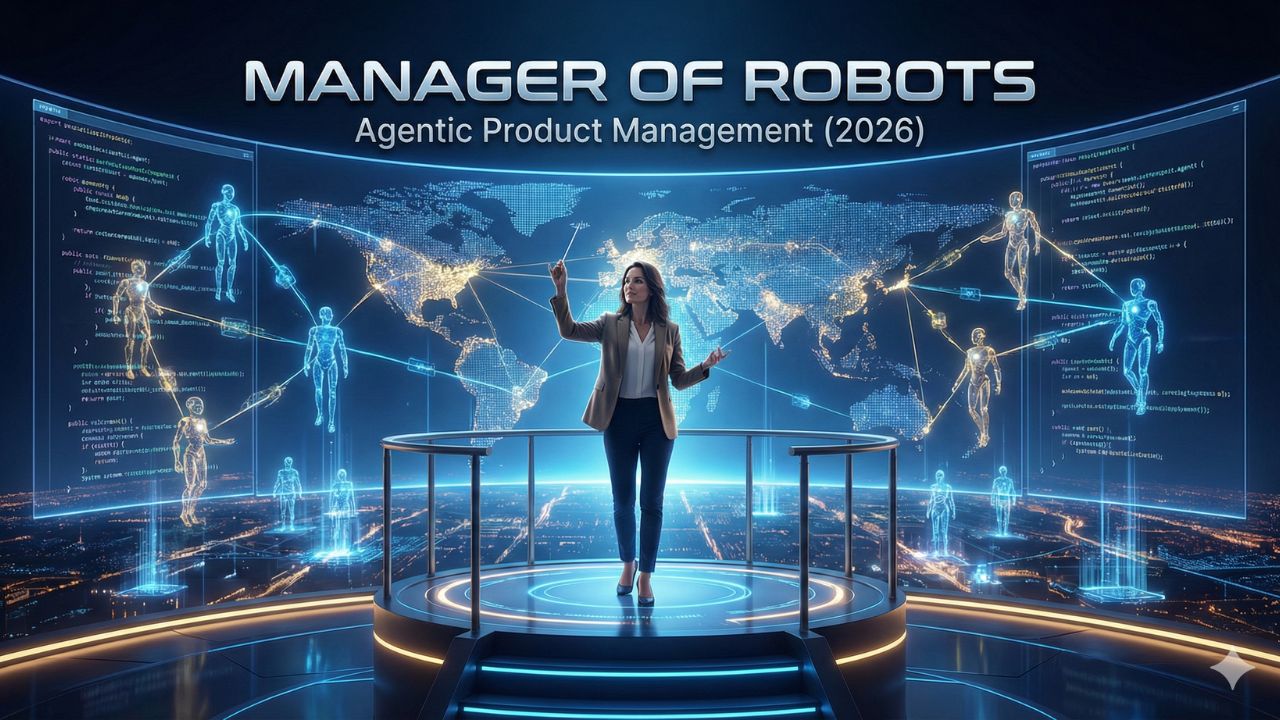
The landscape of product management is undergoing a fundamental transformation. As detailed in the insights from Product Leaders Day India, we are moving away from the 2025 paradigm of "Using Copilots" to the 2026 reality of "Managing Agents." This shift marks the dawn of Generative AI 2.0, where automation moves from single-step assistance to complex, multi-step, autonomous workflows.
While managing synthetic team members is crucial, the ultimate differentiator for a 2026 Product Leader is mastering the underlying orchestration and memory infrastructure required to scale them. The transition to agentic AI is not merely about replacing human workflows with intelligent automation; it necessitates a deep, technical understanding of how these synthetic systems communicate, retain long-term state, and consume computational resources at an enterprise scale. Without a firm grasp on vector databases, secure middleware, and token economics, your most innovative agentic concepts will stall in pilot purgatory. True product leadership now demands balancing visionary UX with rigorous architectural foresight.
The Shift: From "Using Copilots" to "Managing Agents"
In 2025, an AI Copilot was a powerful tool that accelerated the individual contributor. It required human direction and review at every step—a human-in-the-loop for execution. In 2026, the AI Agent represents a paradigm change. An agent is defined by its ability to perform autonomous loops—self-correcting, goal-seeking cycles of operation. This means it can research market needs, draft Product Requirement Documents (PRDs), generate code, deploy A/B tests, and even critique its own output without constant human intervention. Consequently, the Product Manager's role must fundamentally evolve. It is no longer about mere "delivery" of tasks; the role shifts decisively to high-level Orchestration and Governance of this synthetic workforce.
The Difference Between Copilot and Agent
| Feature | AI Copilot (2025) | AI Agent (2026) |
|---|---|---|
| Autonomy | Low. Requires human input for every step. | High. Performs autonomous, multi-step execution loops. |
| Focus | Task assistance (e.g., helping write a function). | Goal achievement (e.g., reducing conversion drop-off by X%). |
| PM Role | User/Executor. | Manager/Orchestrator. |
| Delegation | Step-by-step instructions (User Stories). | Goal Vectors and Guardrail definition. |
The Core Message: Product Manager as the Strategic Leader
Architecting Enterprise Agentic AI at Scale
As we approach the "2026 Capacity Crunch," enterprises are realizing that scaling autonomous workflows is constrained by memory databases, orchestration layers, and compute caps, not just the underlying foundational models. A staggering 50% of agentic AI pilots fail due to infrastructure limitations rather than poor UX. To overcome these hurdles, product teams must transition from treating AI as a conversational novelty to engineering it as a deterministic, scalable software component.
Explore our deep dives on mastering these technical bridges:
- agentic AI pilot-to-production bottlenecks
- multi-agent orchestration workflows
- integrating AI agents with legacy ERP
- AI agent memory limits
- agentic AI token economics
The 2026 Curriculum: Strategic Pillars of Agentic AI
To navigate this shift effectively, product leaders must master four distinct, interconnected strategic areas. Below are the core modules of the Agentic Product Management framework—the required skillset for the next generation of CPOs and VPs of Product.
1. The Agentic PM: Managing Synthetic Team Members
Target Audience: Heads of Product, Senior PMs, Portfolio Managers
This module delves into how to optimally structure a modern product team where operational roles are increasingly filled by autonomous AI agents. We are moving towards a Hybrid Human-AI Product Workforce. For example, roles dedicated to market research, basic QA testing, and routine PRD drafting will be automated by specialized agents.
The critical skill here is shifting from writing prescriptive "User Stories" for humans to defining high-level "Goal Vectors" for agents. This requires a leap in strategic thinking, focusing purely on measurable outcomes.
Key Concept: Goal Vectors & Delegation: Learn to set quantifiable, outcome-focused parameters. Instead of writing a 10-step user story, you simply state: "Optimize the checkout flow until drop-off is less than 20% within the next 7 days, adhering to a maximum compute budget of $500." The agent then self-organizes its tasks (hypothesis generation, testing, deployment, monitoring) to achieve this goal.
Read More: The Agentic PM Guide2. B2A (Business-to-Agent): Designing for Non-Human Users
Target Audience: Product Designers, API Product Managers, Platform Architects
The agentic economy introduces a new, dominant user persona: the customer's personal AI agent. In the near future, significant purchasing decisions—booking complex multi-leg travel, buying B2B SaaS subscriptions, or managing personal finances—will be executed not by a human clicking buttons, but by an autonomous agent querying an API. If your product is not designed for this interaction, you become invisible to the purchasing decisions of the future.
This section covers why the elegance of your visual UI will matter less than the clarity and discoverability of your API documentation. Products must be "machine-readable" and adhere to open standards that allow external agents to discover, interact with, and purchase from your platform reliably and autonomously.
Key Concept: Agent-Ready Architecture: Optimizing your product architecture for "Agent-Readable APIs" (REST, GraphQL, or future Agent-Protocol interfaces) and ensuring your product's data models are explicitly exposed for machine consumption, moving beyond human-centric design patterns.
Read More: B2A Design Guide3. Constitutional Product Management: Governance and Guardrails
Target Audience: Product Owners, Trust & Safety Leads, Legal/Compliance
Autonomous agents are capable of phenomenal speed and efficiency, but their self-direction introduces unprecedented operational and ethical risks. The concept of Constitutional AI must be applied directly to product management.
This module focuses on writing the "Constitution"—a set of hard-coded, non-negotiable ethical and business guardrails that autonomous agents cannot cross. This is the PM's highest responsibility in the agentic era, moving from "What should we build?" to "What mustn't our agents be allowed to build?"
Key Concept: Guardrail Engineering: A formal framework for defining essential boundaries. Examples include setting explicit budget/cost limits for compute expenditure, enforcing brand tone and legal compliance restrictions on all generated content, ensuring adherence to data privacy regulations (GDPR, CCPA), and mandatory human sign-off for actions involving irreversible financial or customer-facing consequences.
Read More: Constitutional PM & Governance4. The Infinite Feedback Loop: Synthetic Evolution
Target Audience: Growth PMs, Product Analytics Specialists, Experimentation Teams
In the synthetic era, the product development lifecycle is compressed to near-zero latency. This is a visual and conceptual deep dive into Synthetic Evolution, where multi-agent systems drive the entire discovery and testing process automatically. The traditional slow cycle of ideation, design, development, and testing is replaced by a continuous loop.
The workflow begins with a Discovery Agent creating a hypothesis, a Development Agent building the required landing pages or features, a Synthetic Traffic/User Agent simulating millions of user interactions, analyzing the resulting data, and a Refinement Agent automatically iterating the product before a human PM ever reviews or approves the final, validated version. This process is about automating product iteration itself.
Key Concept: Automated Product Discovery & Synthetic Users: Utilizing sophisticated digital twin environments and massive-scale "Synthetic Users" to generate continuous, zero-latency feedback loops. This allows the product to self-optimize against a defined Goal Vector (e.g., maximize LTV) in real-time.
Read More: Synthetic Users & Testing
Frequently Asked Questions (FAQs)
Q1: What is the main difference between an AI Copilot and an AI Agent?
A: A Copilot assists you while you work (e.g., helping you write code in 2025). An Agent performs autonomous loops—such as writing, testing, and deploying code—without constant human intervention, requiring you to "manage" it rather than just "use" it.
Q2: Will the "Manager of Robots" role replace Product Managers?
A: No, the role shifts rather than disappears. The Product Manager's focus moves drastically from tactical "delivery" tasks (writing detailed user stories, managing backlog) to strategic "Orchestration and Governance." You become the strategic leader of a synthetic workforce, setting the vision and the boundaries, rather than an individual contributor executing tasks.
Q3: What are "Goal Vectors"?
A: Goal Vectors are the new form of task delegation for AI agents. Instead of writing step-by-step user stories, you define specific, quantifiable, and time-bound outcomes (e.g., "Optimize checkout until drop-off is <20% and conversion rate is >4.5% by end of quarter") and allow the autonomous agent to determine the optimal, unconstrained path to achieve that goal.
Q4: Why do I need to design for "Non-Human Users" (B2A)?
A: In the near future, a significant volume of purchasing and interaction decisions (booking flights, buying software, managing utilities) will be executed by a customer's personal AI agent. If your product's APIs and data are not explicitly "machine-readable," these customer agents cannot discover, interact with, or buy from you. B2A is the essential new channel for product distribution.
Sources & References
- The Rise of Agentic Product Management: Concepts regarding managing synthetic team members and structural team changes.
- Designing for Non-Human Users: Methodologies for B2A (Business-to-Agent) and API-first product strategy.
- Constitutional AI & Governance: Frameworks for AI guardrails, ethics, and risk management in autonomous workflows.
- Synthetic Data & Testing: Research on synthetic users, automated QA, and infinite feedback loops.