This blog is part of Agentic AI Product Management .
The Agentic PM: Managing Synthetic Team Members
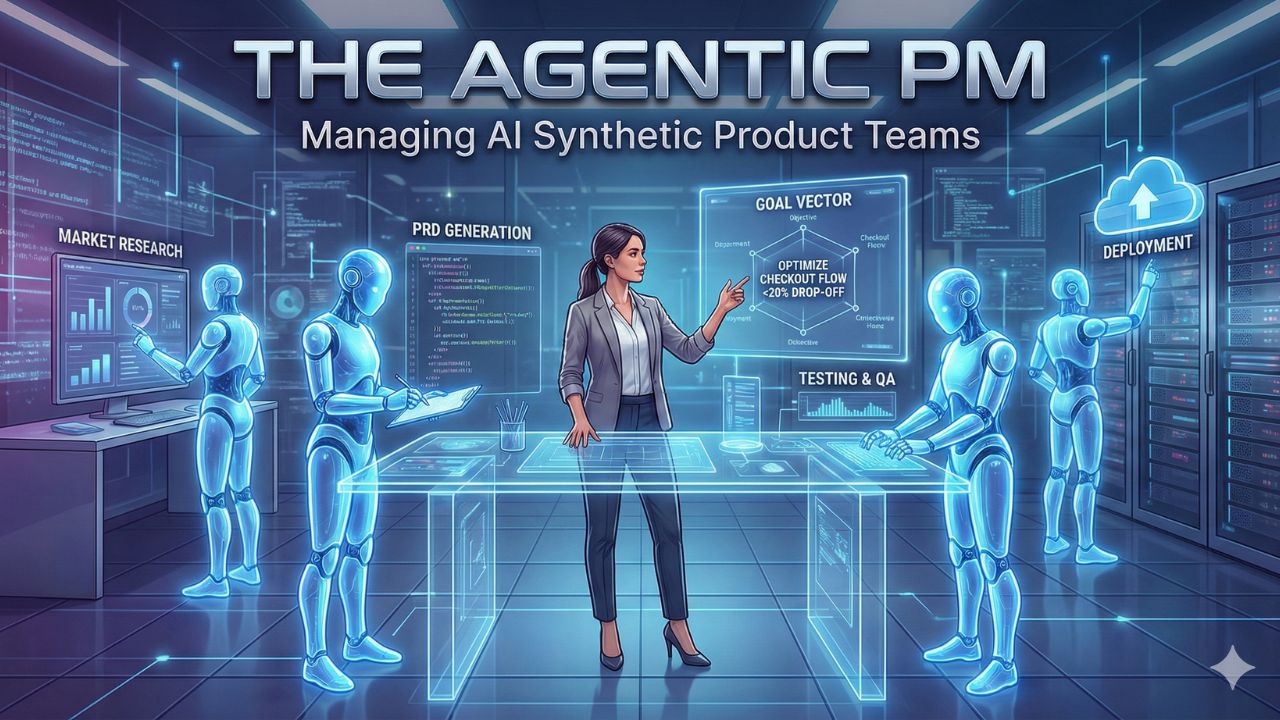
The product management world is experiencing a fundamental transformation, moving from the 2025 paradigm of "Using Copilots" to the 2026 reality of "Managing Agents." This shift is mandatory for product leaders who wish to retain strategic relevance in the near future.
The Manager of Robots Manifesto identifies this module as a core pillar of the Agentic Product Management framework, emphasizing the role shift from task execution to strategic Orchestration and Governance.
Target Audience and The Idea Behind Agentic Product Management
Target Audience: Heads of Product, Senior PMs, Aspiring AI Product Leaders
This module is essential for understanding how to structure a modern product team where roles traditionally held by junior staff, such as "Junior PM," "Product Owner," and "QA Tester," are instead filled by autonomous AI agents. These synthetic team members dramatically increase the velocity of product discovery and delivery.
The Agent vs. Copilot Paradigm Shift
A Copilot is a powerful tool that requires human input for every step, like an advanced spreadsheet. An AI Agent, however, is a synthetic team member capable of completing entire autonomous loops. For example, an agent can autonomously:
- Write feature code based on a high-level goal.
- Simulate user testing with synthetic data.
- Identify bugs and self-correct the code.
- Draft a deployment plan and execute it.
The PM's core responsibility moves from doing the work to governing the work performed by these autonomous entities.
The Core Skill: From User Stories to Goal Vectors
The critical skill for the Agentic PM is a fundamental change in task delegation, moving away from prescriptive instructions toward defining self-driven outcomes.
The Failure of User Stories for AI Agents
User Stories, structured as "As a [User Role], I want [Goal] so that [Benefit]," are fundamentally step-by-step instructions designed for human developers to implement a specific solution. This prescriptive approach starves the AI agent of its greatest asset: its ability to autonomously explore the most efficient path to an objective.
Engineering the Goal Vector
Key Concept: A Goal Vector is the new form of task delegation. Instead of detailing the execution path, you define a clear, quantifiable outcome and allow the autonomous agent to determine the best way to achieve it. This is Goal Engineering, replacing traditional Prompt Engineering.
A Goal Vector is defined by three key components:
- The Objective (The WHAT): The ultimate, measurable outcome (e.g., "Increase daily active users by 10%").
- The Constraint (The HOW MUCH): The guardrails or non-negotiables (e.g., "Must not increase infrastructure costs by more than 5%").
- The Toolset (The WHERE/WITH): The specific APIs, code repositories, or data sources the agent is allowed to access.
Goal Vector Example in Practice
Instead of writing:
"As a user, I want a simpler checkout button so that I can complete my purchase faster." (A vague, solution-oriented user story)
The Agentic PM writes a Goal Vector:
Objective: Optimize the checkout flow until the drop-off rate is less than 20% across all mobile devices. Constraint: Use only A/B tested design changes. Toolset: Access to front-end repository and Google Analytics API. (A clear, outcome-oriented Goal Vector)
The agent will now run an autonomous loop: analyze drop-off data, propose design changes, create synthetic A/B test environments, run tests, and ultimately propose the optimal code change, all while the human PM focuses on the next strategic Goal Vector.
The Agentic PM Role: Orchestration and Governance
The Agentic PM is not replaced; their work is elevated. The focus shifts from the tactical daily grind to high-leverage strategic activities:
1. Orchestration (Strategic Alignment)
This involves defining the portfolio of agents, assigning them high-value Goal Vectors, and managing their interaction. Key Orchestration tasks include:
- Multi-Agent Team Setup: Structuring a "Synthetic Team" (e.g., a 'Research Agent', a 'Code Agent', and a 'QA Agent') and designing the communication protocol between them.
- Goal Dependency Mapping: Ensuring the Goal Vector assigned to the 'Code Agent' is dependent on the insights delivered by the 'Research Agent'.
- Defining Success Metrics: Moving beyond simple task completion to defining Objectives and Key Results (OKRs) for the synthetic workforce.
2. Governance (Guardrails and Ethics)
Since agents operate autonomously, the PM must define the rules of engagement—the ethical, financial, and security guardrails within which the agents must operate. This is the PM's new critical risk-management duty.
- Cost Management: Setting hard limits on compute usage to prevent cost overruns from autonomous, exploratory loops.
- Constitutional AI Frameworks: Integrating ethical constraints that prevent the agent from pursuing a goal if it violates company policy, privacy laws, or user trust.
- Audit and Review: Establishing mandatory human review points (e.g., a "pull request" equivalent) before an agent's autonomous change can go live, ensuring a final quality and ethical check.
Frequently Asked Questions (FAQs)
| Question | Answer |
|---|---|
| What is the main difference between an AI Copilot and an AI Agent? | A Copilot assists you while you work (e.g., helping you write code in 2025). An Agent performs autonomous loops—such as writing, testing, and deploying code—without constant human intervention, requiring you to "manage" it rather than just "use" it. |
| Will the "Manager of Robots" role replace Product Managers? | No, the role shifts rather than disappears. The PM’s focus moves from "delivery" tasks to "Orchestration and Governance". You become the strategic leader of a synthetic workforce rather than an individual contributor executing tasks. |
| What are "Goal Vectors"? | Goal Vectors are the new form of task delegation for AI agents. Instead of writing step-by-step user stories, you define specific outcomes (e.g., “Optimize checkout until drop-off is <20%”) and allow the agent to determine the best path to achieve that goal. |
| What are the main risks of using Autonomous AI Agents? | The main risks include Cost Overruns (agents running infinite loops), Security Breaches (if granted too much access), and Unintended Consequences (the agent successfully meets the objective but creates a negative side effect, requiring robust governance). |
| How does this affect Sprint Planning? | Sprint planning shifts from estimating story points for human effort to defining the value velocity of the synthetic team. The focus moves from estimating time to forecasting outcome achievement based on the assigned Goal Vectors. |
Resources for Agentic Product Management
For further reading on this fundamental shift in product strategy and team structure, consider these resources:
- Agentic AI in Product Development - Understanding the fundamentals of Agentic AI.
- The Rise of the Product Manager of AI (HBR) - A look into the changing PM landscape.
- Goal-Oriented AI: Why Goal Vectors Are the Future of Prompting (Forbes) - Deeper dive into goal vector methodology.
- AI Agent Governance is a New Imperative (Gartner) - Insights on the Governance pillar of the Agentic PM role.
📘 Sources & References
The Agentic PM curriculum is built upon several core areas of research and methodology, which are vital for succeeding in this new era:
- The Rise of Agentic Product Management: Concepts regarding managing synthetic team members and structural team changes, including the shift from traditional to autonomous workflows.
- Constitutional AI & Governance: Frameworks for AI guardrails, ethics, and risk management in autonomous workflows, which is vital for the governance pillar of the PM role and minimizing rogue agent behavior.
- Synthetic Data & Testing: Research on synthetic users, automated QA, and infinite feedback loops, supporting the use of agents for comprehensive testing and rapid product discovery cycles.
- Designing for Non-Human Users: Methodologies for B2A (Business-to-Agent) and API-first product strategy, a related pillar in the manifesto focusing on how products must interact with other autonomous systems.