The End-to-End GCC Ownership Framework Big Tech Hides
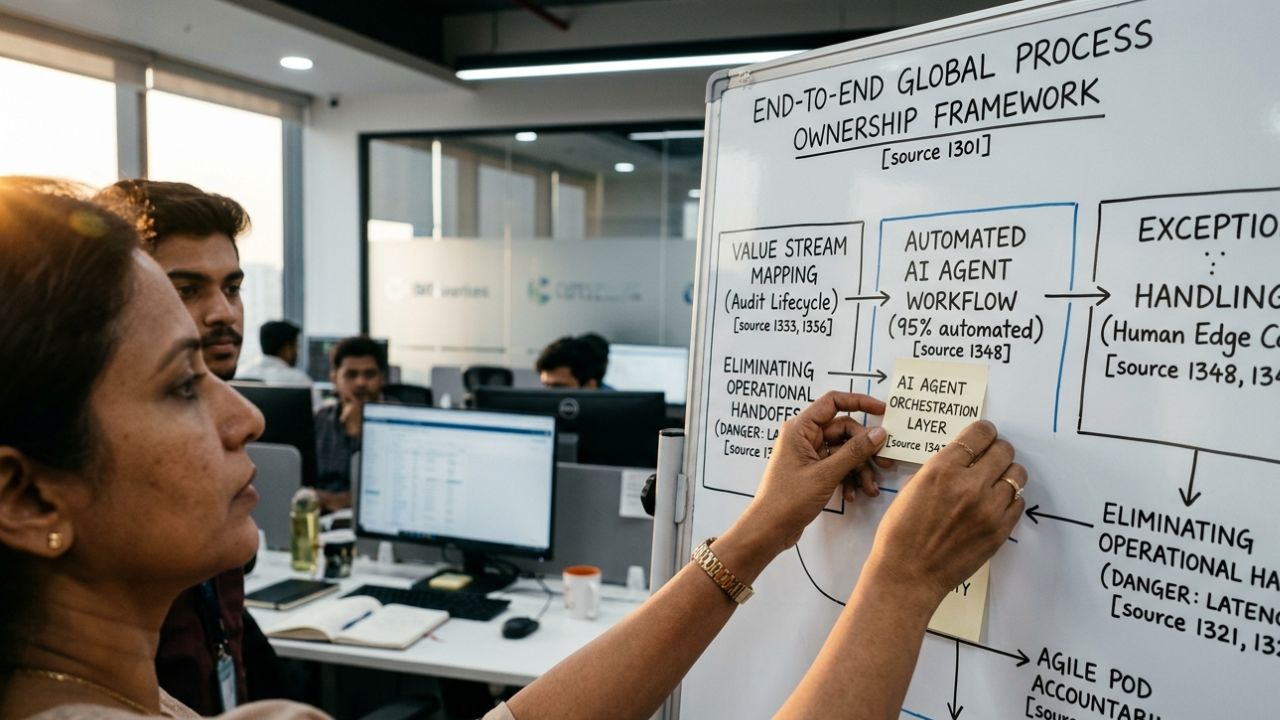
- The Automation Trap: Executing fragmented tasks handed down from HQ is a recipe for automation replacement.
- The New Mandate: You must architect your GCC to own, optimize, and orchestrate the entire global process from end-to-end using AI.
- The Core Strategy: Successfully designing end-to-end global process ownership in GCCs is the definitive strategy to elevate your center from a legacy cost-saver to an irreplaceable enterprise hub.
- Agentic Orchestration: AI agents are the operational bridge that shifts Indian capabilities from manual task execution to full cognitive process management.
- Structural Transformation: End-to-end ownership requires rebuilding your organizational structures and implementing new agile frameworks for non-human models.
If your Global Capability Center (GCC) is still operating as a reactive back-office, you are effectively waiting for obsolescence.
Executing fragmented tasks handed down from HQ is a recipe for automation replacement. To survive the impending capacity crunch, you must completely rethink your operational value.
The secret lies in successfully designing end-to-end global process ownership in GCCs.
Before implementing this blueprint, you must baseline your current operational state by reviewing foundational metrics in India's GCC Performance & Global Benchmarking.
The path forward is clear: you must architect your GCC to own, optimize, and orchestrate the entire global process from end-to-end using AI.
This comprehensive guide unveils the hidden frameworks used by top-tier enterprise hubs to seize full process control, deploy multi-agent AI ecosystems, and secure their future in the modern corporate landscape.
The Paradigm Shift: Task Execution vs. Process Ownership
To understand the urgency of this transition, you must grasp the fundamental difference between task execution and process ownership.
Task execution is linear and isolated. Global HQ initiates a process, hands a localized piece of it to the offshore center, and then takes it back for final approval.
This model is fundamentally flawed in the age of generative AI. Autonomous agents can now perform localized tasks with zero latency and near-perfect accuracy.
Process ownership, however, represents true enterprise value. When a GCC owns a process, it manages the entire workflow from initiation to final resolution.
By designing end-to-end global process ownership in GCCs, you eliminate the operational hand-offs that cause enterprise bottlenecks. You transform your site from an offshore executor into the global brain of that specific capability.
The Danger of the "Handoff"
Every time an offshore team hands a process back to global HQ for approval, they lose leverage. These handoffs are where traditional GCCs bleed value.
- Latency Introduction: Time-zone differences stall approvals, slowing down overall enterprise agility.
- Fragmented Accountability: When multiple centers touch a process, no single entity is responsible for innovating or optimizing it.
- The Automation Target: Highly fragmented, isolated tasks are the easiest workflows for enterprise software to fully automate, threatening jobs.
The Blueprint for Designing End-to-End Global Process Ownership in GCCs
Transitioning an entire global hub requires meticulous strategic planning. You cannot simply request ownership from global executives; you must prove your technical capability to handle it.
Here is the step-by-step framework for designing end-to-end global process ownership in GCCs.
Step 1: Mapping the Value Stream for Autonomous Agents
You cannot own a process you do not fully understand. The first step involves rigorous value stream mapping to identify integration points for AI agents.
- Audit the Full Lifecycle: Document every single touchpoint of a target process, including the steps currently handled by global HQ.
- Identify Cognitive Bottlenecks: Pinpoint where human decision-making slows the process down. These are prime targets for AI model deployment.
- Parameterize the Workflow: Break the global process down into distinct algorithmic stages that can be managed by a multi-agent AI ecosystem.
Step 2: Negotiating Process Control with Global HQ
GCC leaders must strategically negotiate process control with global HQ. This is a delicate political and operational maneuver.
- Start with a "Shadow" Pilot: Run the end-to-end process in parallel with HQ using your new AI-native frameworks. Prove superior speed and accuracy before requesting the official handover.
- Present the AI Output Equivalent (AIOE): Show executives how your center can handle 10x the process volume through agentic orchestration without requiring additional headcount.
- Address Compliance Proactively: Clearly map out how you will mitigate the legal and compliance risks of GCC process ownership, specifically regarding data sovereignty and algorithmic bias.
Step 3: Deploying Agentic AI for Seamless Orchestration
The actual mechanism that enables global process ownership from India is the deployment of autonomous AI agents.
- The Orchestration Layer: Deploy middleware that allows specialized AI models to communicate, negotiate, and execute handoffs autonomously.
- Automated Exception Handling: Design systems where the AI manages 95% of the workflow, and automatically routes complex edge cases to specialized human experts within your GCC.
- Continuous Feedback Loops: Implement agile mechanisms that allow the AI agents to learn from human interventions, constantly optimizing the end-to-end flow.
The Organizational Structures Needed for End-to-End Ownership
You cannot overlay an advanced AI-driven process onto a legacy reporting structure. The organizational structures needed for end-to-end ownership require a complete flattening of traditional hierarchies.
You must dismantle the siloed departments of IT, Finance, and Operations.
Instead, organize your talent into cross-functional, agile pods. These pods act as dedicated swat teams, entirely focused on optimizing the specific global process they own.
The Rise of the AI Scrum Master
In this new structure, traditional project managers are obsolete. You need AI Scrum Masters who understand how to integrate non-human actors into enterprise workflows.
These orchestrators conduct daily stand-ups not just with human developers, but via analytical reviews of AI agent performance dashboards.
They govern the token usage, monitor hallucination rates, and continuously groom the algorithmic backlogs.
To accurately track the success of these new structures, you must completely overhaul your reporting metrics. You must prioritize rebuilding GCC metrics for AI-native enterprise value to prove your center's strategic worth.
Scaling Ownership Across the Global Enterprise
Once you successfully pilot the ownership of one global process, the goal is rapid, horizontal scaling.
How do you scale process ownership across multiple global centers? The answer lies in modularizing your AI architecture.
If your Indian GCC successfully automates the end-to-end financial reconciliation process, you package that AI ecosystem as a proprietary, internal enterprise product.
You then export that operational framework to other regional hubs, effectively transforming your center from a consumer of global workflows into the creator of global enterprise standards.
This is the ultimate evolution of the global business services operating model.
Conclusion: Claiming Your Enterprise Capability
The days of competing on cheap labor and repetitive task execution are permanently behind us. Global hubs that refuse to evolve will be dismantled by algorithmic efficiency.
By actively designing end-to-end global process ownership in GCCs, you fundamentally change the power dynamic of the enterprise.
You move from the back-office periphery to the strategic core.
Start mapping your value streams today, deploy your agile AI orchestrators, and claim the global processes that will secure your center's dominance well into the future.

Frequently Asked Questions (FAQ)
What does end-to-end global process ownership mean for GCCs?
End-to-end global process ownership means a GCC manages a complete enterprise workflow from initial input to final resolution. Instead of executing fragmented tasks handed down from headquarters, the center takes full accountability for optimizing and orchestrating the entire lifecycle, driving true enterprise agility.
How do you start designing end-to-end global process ownership in GCCs?
Designing this ownership begins with rigorous value stream mapping to identify every process touchpoint. GCC leaders must transition from manual task execution, deploy multi-agent AI ecosystems to handle procedural steps, and strategically negotiate the handover of process control with global HQ through successful pilot programs.
What is the difference between task execution and process ownership?
Task execution involves performing isolated, linear activities with frequent hand-offs back to a central authority, making it highly susceptible to automation. Process ownership requires taking complete, holistic accountability for an entire global capability, leading to continuous innovation and the elimination of operational bottlenecks.
How do AI agents enable global process ownership from India?
AI agents act as the connective tissue for complex workflows. By deploying autonomous models to handle high-volume data processing, localized decision-making, and automated exception routing, Indian GCCs can manage massive global processes with near-zero latency, eliminating the need for constant HQ oversight.
What are the organizational structures needed for end-to-end ownership?
End-to-end ownership requires dismantling siloed legacy departments in favor of cross-functional, agile pods. These specialized teams, guided by AI Scrum Masters, combine human strategic oversight with autonomous agent execution, forming an integrated unit solely focused on optimizing a specific global enterprise capability.