Why Your GCC AI Upskilling Program is Guaranteed to Fail
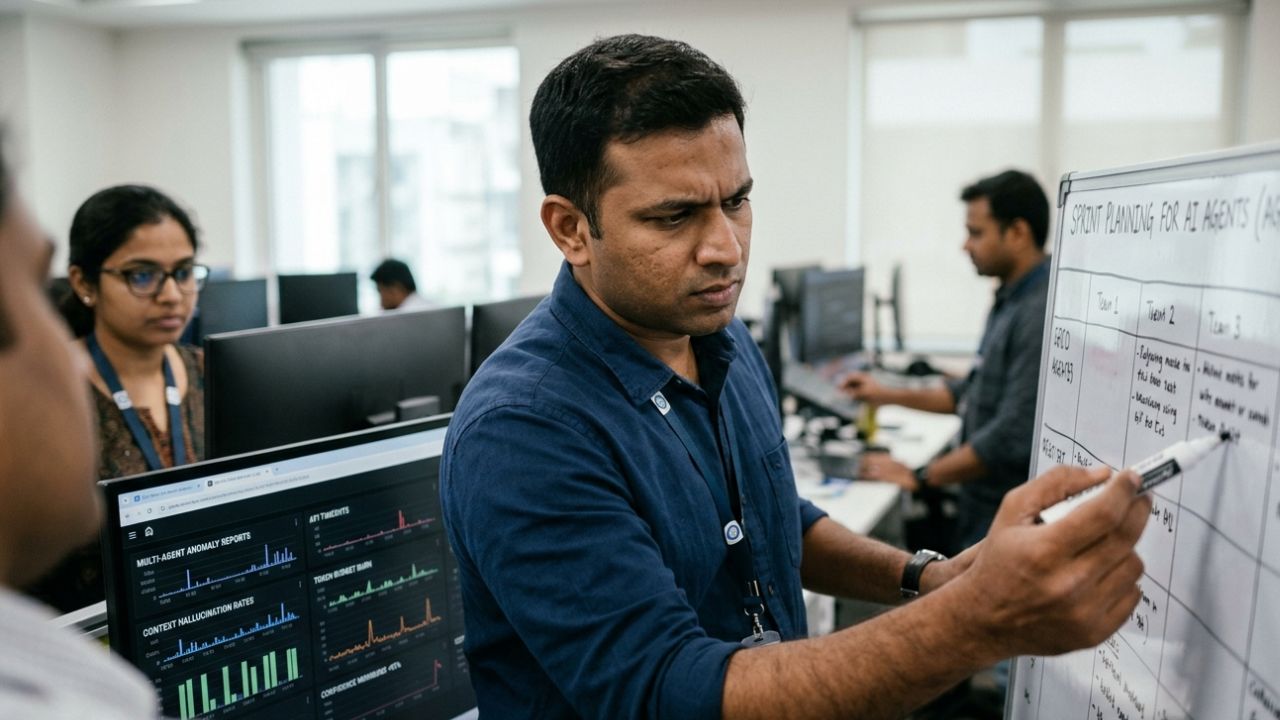
- Prompting is Not Enough: Teaching your developers basic prompt engineering won't save them from the 2026 capacity crunch.
- The Real Skill Gap: Successful upskilling GCC workforces for agentic AI orchestration requires shifting talent from hands-on coding to high-level AI management.
- Bootcamps Waste Budget: Generic bootcamps waste budget because they fail to teach the operational realities of managing multi-agent AI systems.
- Agentic Agile: Treating AI models as active agile team members, complete with rigorous Sprint Planning for AI Agents, is the only sustainable framework.
- The New Roles: You must actively focus on transitioning developers to AI managers who oversee autonomous workflows.
If you are merely teaching your Global Capability Center (GCC) talent how to write better prompts for generative AI, your upskilling program is already obsolete.
Teaching your developers basic prompt engineering won't save them from the 2026 capacity crunch. The enterprise landscape is shifting faster than traditional training matrices can handle.
To survive, you must evaluate your foundational metrics by reviewing India's GCC Performance & Global Benchmarking. Most upskilling initiatives fail because they treat AI as a passive tool, like an advanced calculator.
In reality, modern enterprise AI consists of autonomous agents executing complex workflows. Generic bootcamps waste budget.
You need an advanced curriculum required to train true orchestrators of multi-agent AI systems. This demands a radical shift: upskilling GCC workforces for agentic AI orchestration.
This deep-dive exposes the fatal flaws in current training and provides the definitive blueprint for integrating AI agents into your agile sprint cycles.
The Fatal Flaw in Upskilling GCC Workforces for Agentic AI Orchestration
Global headquarters no longer want offshore centers to just execute fragmented tasks; they want centers that can oversee autonomous ecosystems. Most GCCs respond by purchasing massive licenses for AI coding assistants and calling it "upskilling."
This approach fundamentally misunderstands the future of work in Indian IT. The core difference between coding skills and AI orchestration skills lies in process ownership.
A coder writes a script to perform a task; an orchestrator designs a system where AI agents negotiate, execute, and validate tasks independently.
To properly manage this transition, leaders must first understand the India GCC AI displacement risk and mitigation strategies to map out which roles are most vulnerable.
From Developer to AI Scrum Master
Your upskilling curriculum must pivot aggressively. You are no longer training software engineers; you are transitioning developers to AI managers.
- System Design over Syntax: Training should focus on how to connect multiple AI agents via APIs, rather than writing boilerplate code.
- Governance and Guardrails: Talent must learn how to establish strict operational boundaries for autonomous agents.
- Continuous Monitoring: Upskilling must include advanced dashboard analytics to track AI performance, hallucination rates, and API failures.
If your training program lacks these components, it will not yield a return on investment. The bridge between theory and practical application is Agile methodology—specifically, adapting it for non-human actors.
How to do Sprint Planning for AI Agents (The Missing Curriculum)
The most glaring omission in standard AI training is operational integration. You cannot simply unleash autonomous agents into a production environment.
You must train employees to manage AI agents within a structured delivery framework. This is where the concept of Sprint Planning for AI Agents becomes critical.
To orchestrate effectively, your human workforce must treat AI models as specialized members of the Scrum team. Here is the blueprint you must integrate into your upskilling program.
1. Grooming the Agentic Backlog
AI agents lack human intuition. They require flawlessly groomed backlogs. During backlog refinement, human orchestrators must break down broad user stories into algorithmic micro-tasks.
- Parameterizing the User Story: Your upskilled talent must learn to define the exact data inputs, APIs required, and the rigid structural outputs expected from the AI.
- Setting the Guardrails: Training must emphasize how to write "Negative Constraints." Orchestrators must explicitly define what the AI agent is not allowed to execute independently.
- Assigning Human-in-the-Loop (HITL): Every AI-driven user story must have a designated human reviewer mapped to it for quality assurance and compliance validation.
2. Capacity Planning for Non-Human Actors
While an AI does not get tired, it is absolutely bound by infrastructure constraints. A key part of enterprise AI reskilling is teaching teams how to forecast technical capacity during sprint planning.
- Forecasting API Rate Limits: Orchestrators must calculate the expected volume of API calls the agent will execute to prevent the system from throttling mid-sprint.
- Establishing Latency Budgets: AI management training must cover how to estimate processing times for complex generative tasks, ensuring strict enterprise SLAs are maintained.
- Monitoring Token Costs: Teams must be trained to map out token usage limits. An AI agent running an infinite loop can drain a department's budget in minutes if not planned for during the sprint.
3. Redefining the "Definition of Done" (DoD)
Standard coding metrics do not apply to agentic AI. Upskilling programs must teach teams to redefine the Definition of Done (DoD) using mathematical confidence rather than subjective review.
- Mandating Confidence Minimums: Teams must configure the AI agent to output a confidence score. A typical DoD might require a score of 95% or higher for the task to be marked complete.
- Automating Exception Handling: If the AI's confidence score drops below the threshold, the orchestrator must build logic that automatically routes the ticket back to a human queue.
- Enforcing Compliance Logging: Before an AI ticket is closed, the system must securely log every automated action taken, ensuring full auditability for enterprise compliance.
4. The Agentic Daily Stand-Up
The final piece of the curriculum is changing the daily operational rhythm. In an AI-native GCC, the daily Scrum shifts from asking human developers for status updates to aggressively monitoring dashboards.
- Analyzing Anomaly Reports: Human orchestrators must be trained to analyze error logs, API timeouts, or data hallucinations generated by the AI overnight.
- Iterating Prompts Mid-Sprint: If an agent is repeatedly failing a specific task, the human orchestrator must step in to adjust the system prompts and fine-tune the behavior immediately.
- Unblocking the Pipeline: The team's primary goal shifts to unblocking broken data pipelines or resolving access issues that prevent the AI agents from clearing their automated queues.
This operational rigor is the cornerstone of true Enterprise Agentic AI Scaling.
Overcoming Resistance and Rebuilding the Talent Pipeline
Transitioning your workforce requires cultural change management alongside technical training. You will face pushback from employees who fear they are training their digital replacements.
You must overcome employee resistance to AI training by reframing the narrative. You are not replacing them; you are elevating them.
By moving them out of routine execution and into the command center, you are future-proofing their careers against the impending automation cliff.
Partnering for the Future
Internal bootcamps are rarely sufficient for this scale of transformation. GCCs must partner with universities for AI talent, co-creating curriculums that focus specifically on multi-agent system design and agile AI orchestration.
The cost of reskilling a GCC employee for AI is insignificant compared to the cost of letting your center slip into obsolescence. The GCCs that thrive in 2026 will be those that aggressively invest in this exact brand of high-level systems training.
Conclusion: Securing Your Talent Investment
The traditional playbook for enterprise training is broken. Rebuilding your talent pipeline today requires abandoning the illusion that a few hours of generative AI tutorials will secure your center's future.
If you want to protect your budget and elevate your operations, you must commit to upskilling GCC workforces for agentic AI orchestration. Stop teaching your developers how to code for AI, and start teaching them how to manage, govern, and execute Sprint Planning for AI Agents.
By transforming your human workforce into elite AI orchestrators, you ensure your GCC remains an irreplaceable pillar of global enterprise value.

Frequently Asked Questions (FAQ)
What is agentic AI orchestration?
Agentic AI orchestration is the management and coordination of multiple autonomous AI agents to execute complex, end-to-end enterprise workflows. It involves designing systems where AI models can negotiate, self-correct, and complete multi-step tasks with minimal human intervention.
How do you upskill an IT workforce for autonomous AI?
Upskilling requires moving away from basic coding bootcamps. The focus must shift to systems thinking, teaching employees how to deploy, monitor, and establish guardrails for AI agents. Training should heavily emphasize integrating AI into existing agile and sprint planning methodologies.
What are the best training programs for upskilling GCC workforces for agentic AI orchestration?
The best programs abandon generic prompt engineering and instead focus on AI management and multi-agent system design. They include advanced curriculums on API integration, token budget management, automated exception handling, and redefining agile sprint ceremonies for non-human actors.
How do you train employees to manage AI agents?
Employees must be trained to act as AI Scrum Masters. This involves teaching them how to groom agentic backlogs, define strict technical parameters, monitor confidence score thresholds, and conduct daily analytical reviews to correct AI hallucinations or unblock data pipelines.
What is the difference between coding skills and AI orchestration skills?
Coding skills focus on writing manual syntax to execute a specific, static function. AI orchestration skills focus on high-level system design, governance, and process management, enabling a human operator to guide and oversee multiple autonomous models solving dynamic problems globally.