MVP vs Prototype: Most Teams Test the Wrong Thing
- Prototypes test feasibility: They exist solely to prove that your engineering and design teams can physically execute the proposed architecture.
- MVPs test viability: They are deployed into the live market to prove that a customer will actually pay for or adopt the solution.
- Never mix the two: A technical prototype cannot validate commercial market demand, and an MVP is far too expensive to use for basic feasibility testing.
- Value exchange is mandatory: A true Minimum Viable Product requires the user to give up time, money, or proprietary data to prove intent.
MVP vs prototype isn't semantics—confuse them and you test feasibility when you needed demand. The distinction that saves a build cycle. See which to run.
When product and engineering teams misuse these terms, they inherently misalign their entire strategic roadmap. Engineering builds a technical proof of concept to see if the architecture holds up, while leadership mistakenly believes they are testing actual market demand.
This corporate misalignment is exactly why so many enterprise companies ship fully functional, highly optimized software features that absolutely no one buys.
Establishing clear definitions and rigid test boundaries is the non-negotiable core of lean product validation. Stop wasting engineering sprints testing the wrong variables.
The Fatal Cost of Confusing Feasibility with Viability
Teams naturally gravitate toward building what they know. For software engineers and product designers, building a complex interactive model is comfortable.
They spend weeks crafting elegant code spikes or detailed user flows, calling this effort their "MVP." This is a catastrophic strategic error.
You are spending valuable capital answering an engineering question when the business is facing an existential market threat. If your product lacks desirability, perfect technical feasibility means nothing. You will have successfully engineered a completely useless application.
Prototypes Answer "Can We Build It?"
A prototype isolates technical and usability risks. It allows your developers to test complex API integrations and lets your designers observe how users navigate a new interface.
The data gathered here is strictly functional. It answers whether the system crashes under load or if the user can find the checkout button.
It never answers if they actually want to check out.
MVPs Answer "Should We Build It?"
An MVP isolates business and commercial risk. It operates in the wild, forcing real users to make actual purchasing or adoption decisions.
If your test does not require the user to open their wallet or alter their daily operational habits, you are not running an MVP.
Anatomy of a Code-Heavy Prototype
Prototypes are built using mock data, controlled environments, and sandbox accounts. The user interacting with the prototype explicitly knows they are participating in a test.
Because the user knows the stakes are completely artificial, their feedback is inevitably skewed. They will tell you the feature is "great" because it costs them nothing to be polite.
If you are trying to measure early intent before building a prototype, you must shift your focus further upstream toward pretotyping to capture raw behavioral signals first.
Defining the True Minimum Viable Product
A functional MVP strips away the artificial safety net. It puts a genuine value proposition in front of a cold audience and demands a real-world transaction.
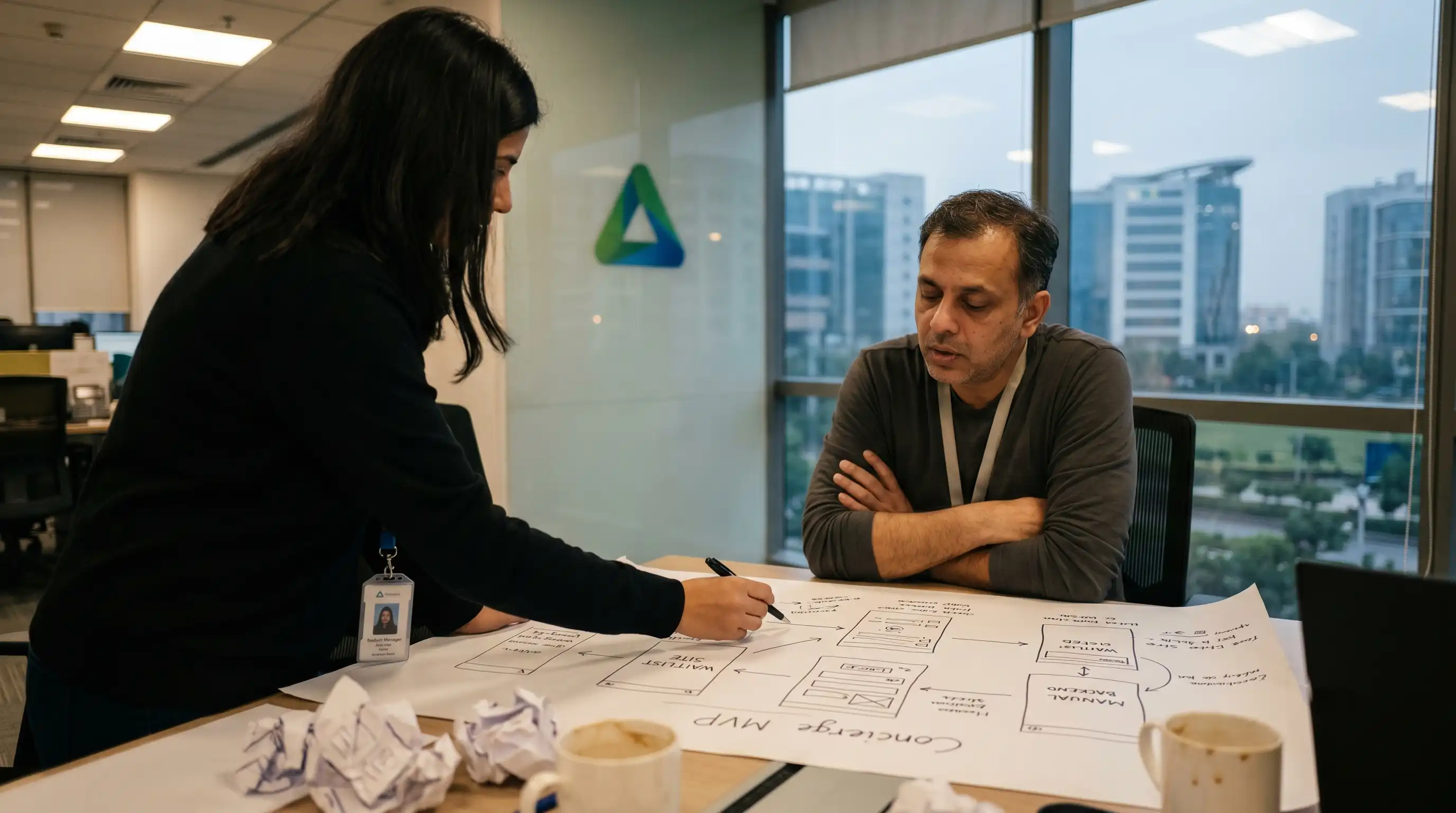
Many successful MVPs contain almost no backend code. They utilize manual human effort to fulfill the software's promise behind the scenes.
Understanding the nuances between these manual setups—such as a Wizard of Oz vs Concierge MVP—is critical for capturing authentic market data without spending your engineering budget.
The Role of Value Exchange
To qualify as an MVP, a strict value exchange must occur. The customer must surrender something of finite value.
This could be an upfront monetary deposit, a signed B2B letter of intent, or the integration of their live corporate data.
Without this friction, you do not have an MVP; you have an interactive brochure.
The Validation Ladder: Sequencing Your Tests
You do not choose between a prototype and an MVP. You must sequence them sequentially based on your most immediate product risk.
If your core risk is whether an algorithm can process data fast enough, build a technical prototype immediately.
If your core risk is whether enterprise administrators will actually pay for that processed data, bypass the code and launch a manual MVP. Let objective customer behavior dictate your technical roadmap.
Conclusion & CTA
Debating the definitions of an MVP and a prototype is not an academic exercise. Confusing these two frameworks actively burns engineering capital and results in building products that the market fundamentally rejects.
Stop using prototypes to ask customers if they like your idea. Audit your current sprint backlog today.
If your team is calling a feature an "MVP" but it doesn't require the user to pull out a credit card or commit real resources, halt development and restructure your test. Let actual market behavior drive your roadmap.

Frequently Asked Questions (FAQ)
A prototype is an engineering or design model built specifically to test technical feasibility and usability. An MVP, however, is a functional business vehicle deployed to real customers to test market demand, unit economics, and actual user willingness to pay.
You should build a prototype when your primary risk is technical execution or complex usability. If you do not know if your team can physically engineer the system, prototype the architecture before spending your product budget on a live MVP.
No, it does not. A prototype can simply be a static set of design wireframes, a clickable visual mockup, or a rudimentary backend code spike. Its singular goal is to simulate the proposed experience to answer a specific technical question.
An MVP directly answers the core business question: "Will customers actually buy or use this?" A prototype cannot answer this because testers know it is a simulation. MVPs measure real behavioral commitment and financial viability in a live, competitive market.
A clickable prototype is never an MVP. While it is excellent for testing usability and gathering subjective user feedback, it requires absolutely no real-world commitment from the tester. Consequently, it cannot reliably validate actual commercial demand or authentic pricing elasticity.
A prototype almost always comes first. You must determine if users can navigate the interface and if engineers can build the infrastructure. Once feasibility and usability are de-risked, you can launch a minimal MVP to test the actual market desirability.
A prototype is typically a clickable Figma design file or a local backend script testing database loads. An MVP is a live, public-facing service—often executed manually behind the scenes—that captures real credit card payments from authentic target customers.
No, a prototype cannot validate market demand. Prototypes only capture user opinions and usability feedback. Because the user is not trading real money, proprietary data, or extensive time to use the prototype, their feedback remains hypothetical rather than strictly behavioral.
An MVP is generally much more expensive to run than a prototype. While a product designer can build a clickable prototype in an afternoon, an MVP requires live hosting, functional payment gateways, and real customer support to capture authentic data.
A pretotype tests initial market interest before anything is actually built. A prototype tests if the engineering team can technically design and build the architecture. An MVP is the first functional version released to validate ongoing customer retention and viability.