Lean Product Validation: The Evidence-Guided Way
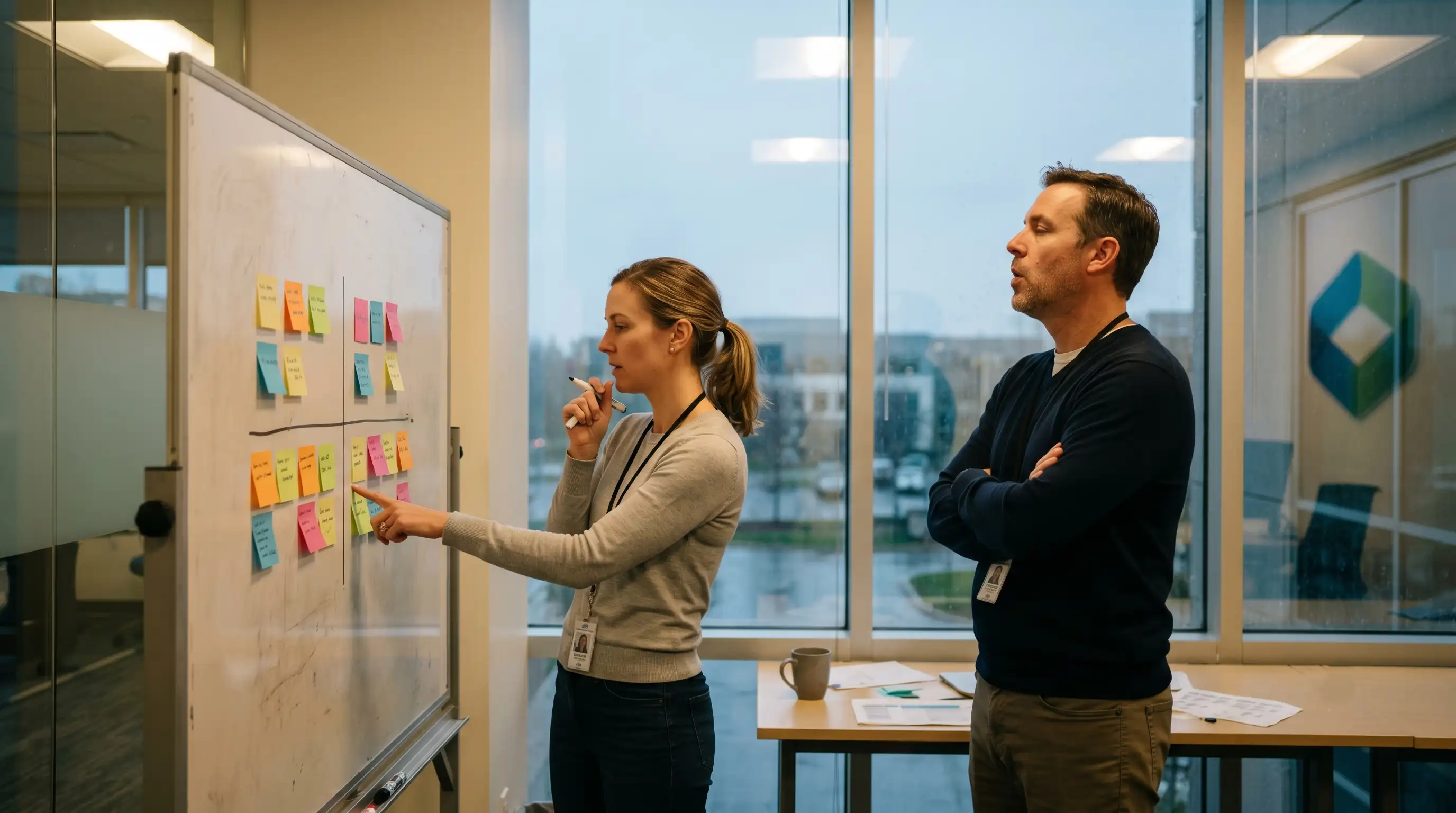
- Validate the riskiest assumption, not the easiest. Most teams test what they can, not what would kill the idea.
- Match the method to the question. Demand risk → fake door or landing page. Usability → pretotype. Will-they-pay → concierge or pre-sale. Feasibility → prototype.
- Set the pass/fail line before you look. Deciding the threshold after seeing results is how teams "validate" anything they want.
- Watch behaviour, not opinions. A signed commitment beats a thousand "I'd definitely use that" replies.
- It's a habit, not a phase. Continuous discovery keeps evidence flowing after launch, not just before it.
Your team is busy, your roadmap is full, and almost none of it has been tested against a real customer's behaviour. So you build—politely, expensively—and a quarter later the launch lands with a thud while the analytics fill up with numbers that look like progress and prove nothing.
This lean product validation guide replaces the build-and-hope reflex with an evidence-guided sequence: map the risk, test the riskiest assumption first, and let real behaviour—not internal enthusiasm—decide what gets built.
What "Evidence-Guided" Actually Means (and Why "Lean" Got Hijacked)
Somewhere along the way, "lean" came to mean "cheap and fast." That is not what it means. Lean product validation is about one thing: maximising validated learning per unit of effort and money spent.
The goal is not to build a smaller product sooner. The goal is to be less wrong before you commit. Evidence-guided simply means a build decision is backed by observed customer behaviour, not by the loudest opinion in the room.
The mental model that ties this together is the build-measure-learn loop—but run deliberately, with the riskiest question first. We unpack how to sequence that engine correctly in our breakdown of the build-measure-learn loop.
The four risks every idea carries
Every product idea hides four distinct risks, and they are not equally dangerous. Naming them tells you what to test.
- Desirability: do customers actually want this? Usually the biggest and least-tested risk.
- Viability: does it work for the business—will they pay enough, often enough?
- Usability: can people figure out how to use it?
- Feasibility: can we build it? This is the one engineers love to test first—and rarely the one that kills the idea.
Validation, proof of concept, and market research are not the same thing
A proof of concept answers "can we build it?" Market research describes a market. Validation answers "should we build it, and will anyone act on it?"
A team can win all three of those games and still fail, because a technically brilliant, well-researched product nobody changes their behaviour for is still a dead product.
This idea of mapping evidence to confidence has deep roots in our earlier work on the Truth Curve, which remains the cleanest model for how much certainty a given piece of evidence actually buys you.
The Misconception That Quietly Wastes Quarters: "Validation Theatre"
Here is the uncomfortable truth most validation programmes never confront: the majority of "experiments" run inside product teams are designed to confirm the idea, not to risk killing it.
That is validation theatre. The test is rigged—not maliciously, but structurally. Leading survey questions, demos shown to friendly users, a pilot with the one customer who already loves you. The result feels like evidence and functions like permission.
Real validation runs the opposite way. The strongest experiment is the one your idea could plausibly fail. If a test cannot return a result that stops the project, it is not testing anything—it is generating reassurance.
The second, related misconception is that the MVP is a small version of your product. It is not. The MVP is the smallest thing that produces a real learning, and most "MVPs" are simply under-resourced v1s that test feasibility while the actual risk was desirability all along.
Map the Risk Before You Test It
You cannot test everything, and you should not try. The first move is not an experiment—it is a map.
Assumption mapping: rank by impact and uncertainty
List every belief the idea depends on, then plot each on two axes: how much it matters if you are wrong, and how sure you actually are. The dangerous quadrant is high-impact, high-uncertainty—the assumptions that can sink the roadmap and that nobody has evidence for.
The full workshop method, including the 2x2 most teams skip, is in our guide to assumption mapping.
The riskiest assumption test: order is everything
Once mapped, you attack the riskiest, most-uncertain, cheapest-to-test assumption first. Testing the comfortable assumption first is the most common way to burn weeks and learn nothing that mattered.
We cover the sequencing trap—and how to design a fair test—in the riskiest assumption test.
The Experiment Ladder: From Pretotype to MVP
Validation methods form a ladder of escalating commitment. You climb only as far as the evidence forces you, spending the least money for the strongest signal you can get at each rung.
Pretotyping: "will they use it?" before "can we build it?"
A pretotype tests whether people will engage with the promise of a thing before any version of the thing exists. It is the cheapest rung and the most skipped. Full techniques are covered in our piece on pretotyping.
Demand tests: fake doors and landing pages
The next rung measures real intent. A fake door test places a button or feature that does not yet exist and counts who tries to walk through it—detailed in our fake door test guide.
A close cousin is the standalone demand page: a single landing page that promises the value and measures whether strangers will sign up or pay. The setup, and the metric most teams misread, is in how to smoke-test demand with a landing page.
Concierge, Wizard of Oz, and the MVP itself
Higher rungs trade speed for realism: you manually deliver the value (concierge) or fake the back end while the front looks real (Wizard of Oz). Our classic comparison of Wizard of Oz versus Concierge MVPs still maps these cleanly.
Only at the top of the ladder does a true MVP make sense—and it is routinely confused with a prototype, which tests an entirely different risk. We settle that distinction in MVP vs prototype.
Measuring What Matters: Kill the Vanity Numbers
Evidence is only as honest as the metric behind it. Vanity metrics—total signups, page views, cumulative downloads—only ever go up, which makes them useless for a decision and dangerous in a board deck.
The fix is to replace them with actionable metrics tied to a behaviour and a cohort: not "10,000 signups" but "what share of last week's signups came back and completed the core action." We make the full case in why your vanity metrics are lying to the board.
From One-Off Tests to a Discovery Habit
The biggest shift in mature teams is that validation stops being a phase before build and becomes a continuous rhythm around it.
The opportunity solution tree
An opportunity solution tree keeps that rhythm honest by tying every experiment back to a target outcome and a real customer opportunity—so discovery produces decisions, not just activity. We strip it back to the essentials in the opportunity solution tree.
A continuous discovery cadence
The habit that powers it is a weekly touchpoint with customers, held by the people who build the product. The cadence most teams get wrong is detailed in continuous discovery.
If you want the intellectual lineage behind all of this—the disciplines that made evidence-led product work credible—our older notes on hypothesis-driven development and the experimenter mindset of innovation still hold up.
The Two-Week Validation Sprint
Here is how a single, disciplined validation cycle runs end to end. Compress or extend the clock, but keep the order.
Days 1–2 — Map and choose. Run assumption mapping, pick the single riskiest assumption, and write the kill-condition sentence. Nothing gets tested until that line exists.
Days 3–4 — Design the fairest possible test. Select the lowest rung on the ladder that can produce a result capable of failing. Define the metric and the threshold now, in writing.
Days 5–9 — Run and collect. Put the test in front of real users with real stakes. Resist the urge to "explain" the product to participants—that contaminates the signal.
Days 10 — Decide out loud. Compare the result to the pre-set threshold and commit to persevere, pivot, or kill. Record the decision and the evidence so the next funding gate inherits the learning instead of repeating the debate.

Turn These Validation Tactics Into a Repeatable Skill
Reading about lean validation is one thing; running it under real stakeholder pressure is another. The Professional Product Discovery and Validation (PPDV) class puts you through a full validation loop — Business Problem Statement, Test Card, evidence-based decision — on a live product case, so it becomes reflex, not theory.
Explore the PPDV Course →One-day hands-on class with Sanjay Saini (PST) · next cohort Friday 24 July 2026, 10:30 AM–5:00 PM IST.
Frequently Asked Questions (FAQ)
Lean product validation is the practice of reducing risk by gathering real evidence before committing to build. Instead of shipping a full product and hoping, you run small, fast experiments that test whether customers want, will use, and will pay for the idea.
Market research describes a market through surveys and reports; lean product validation tests a specific solution through behaviour. Research tells you what people say; validation watches what they actually do—clicking, signing up, or paying—which is far stronger evidence for a build decision.
Map your assumptions, rank them by risk, then test the riskiest first with the cheapest experiment that could disprove it. Set a pass-fail threshold in advance, run the test, and decide to persevere, pivot, or kill. Repeat until confidence is earned, not assumed.
Start with the demand and desirability risks, not the build. Use a pretotype, fake door, or landing page test to see if real users act on the promise. If they won't click, sign up, or pay for a stub, they won't use the finished product.
Enough to clear the riskiest assumptions, not to eliminate all doubt. Stop when the cost of the next experiment exceeds the cost of being wrong, or when evidence is strong and consistent. Over-validating a low-risk idea wastes the same runway as under-validating a risky one.
A proof of concept tests feasibility—can we build it? Validation tests desirability and viability—should we build it, and will anyone want it? A POC can succeed technically while the idea fails in the market, which is why feasibility alone is never validation.
Run the cheapest test that targets your riskiest assumption. For most new ideas that is demand: a fake door or landing page test. Only move to concierge or MVP-level effort once desirability is proven, since those cost far more to run.
With small numbers, depth beats statistics. Use letters of intent, pre-sales, concierge tests, and structured interviews with buyers rather than chasing significance. Five serious enterprise conversations and one signed commitment tell you more than a thousand anonymous clicks ever could.
Running tests your idea cannot fail, confusing activity with evidence, trusting vanity metrics, testing the easy assumption instead of the fatal one, and deciding the threshold after seeing the result. Each one produces false confidence and the costly build it was meant to prevent.
It fails when real users, given a real chance to act, don't—and a threshold you set beforehand is missed. The discipline is pre-committing to that line. Without it, teams reinterpret weak results as encouraging and build anyway, which defeats the purpose.