The Riskiest Assumption Test Teams Run Too Late
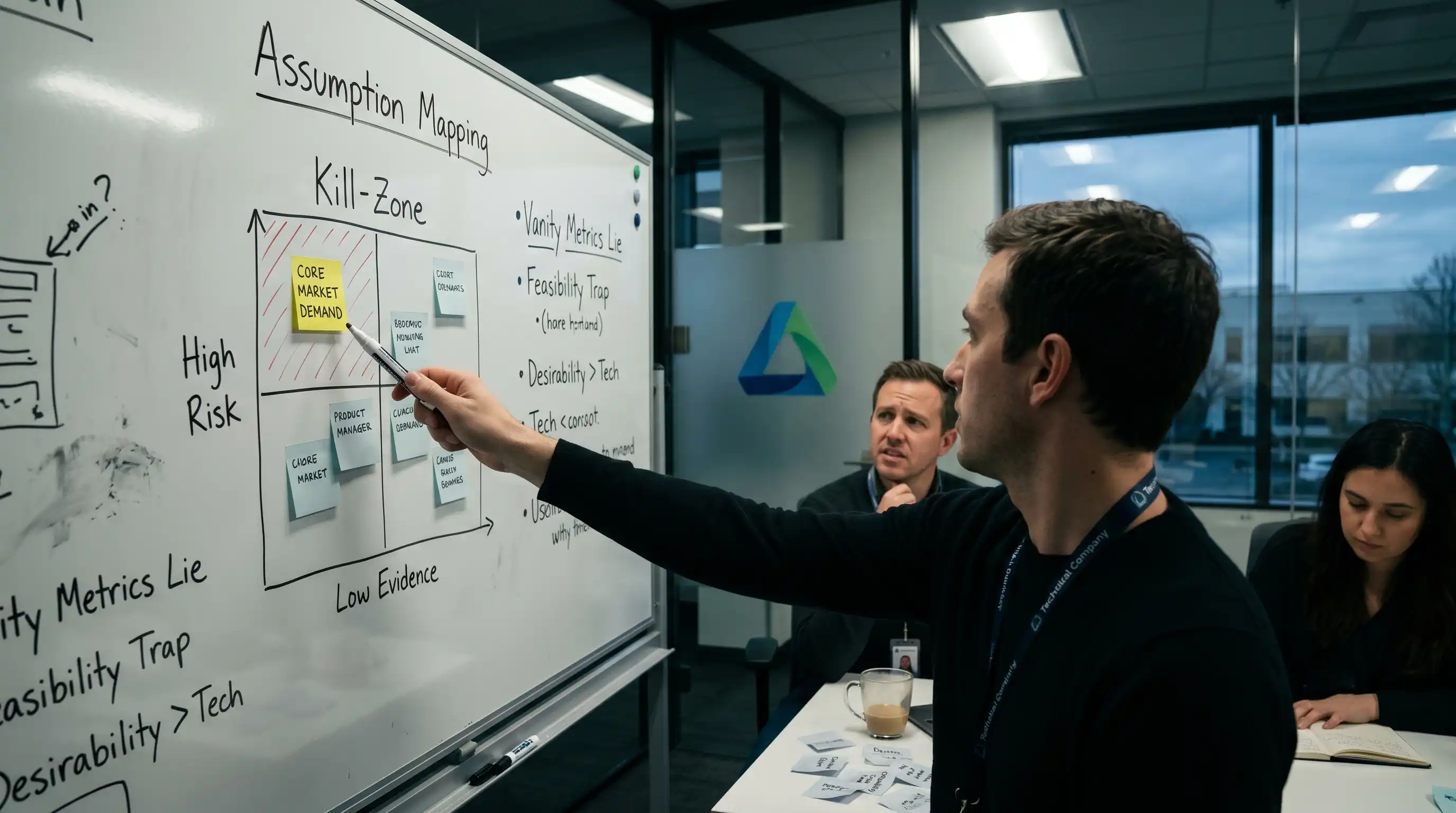
- De-risk fatal flaws first by explicitly choosing to test the assumptions that carry the highest business failure cost.
- Stop confusing execution with validation by ignoring standard engineering feasibility milestones until product desirability is proven.
- Establish objective kill-conditions prior to gathering live user analytical data to eliminate confirmation bias.
- Minimize software waste by deploying strict, un-coded test stubs to capture true behavioral intent metrics instantly.
Most product engineering sprints burn valuable capital building foundational code for features that customers never actually requested. This occurs because engineering frameworks lean heavily toward resolving architectural ambiguity instead of addressing core market demand signals directly.
To break this loop, product teams must embed a systematic riskiest assumption test into their discovery lifecycle. Doing so ensures that you validate critical market dependencies before writing a single line of production software.
This technical practice integrates directly with your overarching framework for lean product validation, turning speculative product roadmaps into structured, evidence-guided delivery pipelines. The riskiest assumption test fails when teams test the easy assumption first.
Why Teams Default to the Easiest Assumption Test First
The Comfort Trap of Feasibility Testing
Engineering groups naturally prioritize problems they know how to solve with code. Building authentication services, database schemas, and microservice structures feels like tangible progress.
This technical bias creates a false sense of security across leadership teams. The organization clocks steady velocity, tickets close in Jira, and code deploys to staging servers. Yet, this entire process operates under a major structural blindspot.
You are systematically verifying that your engineers can build the software, while ignoring whether the market actually requires it.
Why Saving the Real Deal-Breaker for Last Destroys the Runway
Postponing your true value-proposition tests to the end of the delivery cycle creates a massive capital risk. When you finally launch, you frequently discover that user engagement is completely absent.
By the time this behavioral data surfaces, your funding runway is completely depleted. The team has spent months optimizing complex architecture for an unvalidated value proposition.
Had the critical demand constraints been tested openly on day one, the initiative could have been pivoted or shut down at a fraction of the cost.
Decoupling Desirability, Viability, and Feasibility Risks
Isolate and Attack the Core Vulnerability
Validating an architectural concept requires separating your core business assumptions into distinct testing pillars. Blending these risks leads to muddy data signals.
- DESIRABILITY: Do they want it? (Behavioral clicks, signups)
- VIABILITY: Will they pay? (Pre-sales, LOIs, deposits)
- USABILITY: Can they use it? (Clickable user test stubs)
- FEASIBILITY: Can we build it? (Spikes, API sandboxes)
You must identify which of these architectural categories holds the most immediate existential threat to your current product roadmap model. For the majority of modern B2B SaaS configurations, the primary threat is almost never engineering execution.
The existential risk lies entirely within customer desirability and financial viability. To successfully map these dangerous variables out before choosing your next experiment, your product leadership trio should run a dedicated assumption mapping workshop.
Designing a Fair, Code-Free Riskiest Assumption Test (RAT)
Defining clear thresholds before looking at results
An objective experiment framework requires setting clear quantitative thresholds before launching a live test stub. This step prevents teams from rewriting success criteria after the fact.
For instance, if you deploy a functional landing page test, commit to an explicit conversion target beforehand. Decide that less than an 8% behavioral click-through rate means the idea fails validation.
Identify High-Impact Uncertainties
Establish Strict Pass/Fail Metrics
Deploy Low-Cost Behavioral Test Stub
Does Data Exceed Threshold?
Advance to Next Rung
Pivot / Kill Initiative
Maintaining this rigorous operational protocol is the only way to shield your discovery lifecycle from validation theatre. It forces your team to respect clean data signals over internal product opinions.
This process is a core pillar of modern hypothesis driven development, where product metrics override corporate assumptions.
Moving from RAT Validation back to the Broader Experiment Loop
Executing a rapid validation test is not a standalone event. It functions as an iterative filtering mechanism designed to protect your core engineering resources.
Once a core business assumption clears its objective behavioral target, you can confidently invest more capital. The team can safely move up the validation ladder toward high-fidelity interactive models.
By running these technical tests early, you ensure that your delivery pipeline processes nothing but highly verified market opportunities.
Conclusion
Building products based on unverified team assumptions is the fastest way to burn your technical runway. Prioritizing execution speed over market validation only helps you build the wrong application faster.
Stop letting engineering bias dictate your product roadmap prioritization. Audit your feature backlog this week, isolate your highest-impact unknown dependencies, and deploy a code-free test stub to capture real user data before planning your next software development cycle.

Frequently Asked Questions (FAQ)
A riskiest assumption test is an explicit validation practice used to collect operational evidence for the single most critical belief supporting a product concept. It focuses entirely on uncovering fatal project assumptions using the smallest possible amount of time and effort.
You identify this asset by running a structured team mapping session. Evaluate all underlying project dependencies against two distinct operational factors: the total severity of impact if the assumption is wrong, and the current level of objective empirical data backing it up.
An MVP is a functional vehicle engineered to test multiple product usage and retention cycles over time. A riskiest assumption test is a targeted, often un-coded validation stub built exclusively to confirm or disprove a single isolated business vulnerability immediately.
You must consistently test customer desirability and unit economic viability before looking at technical execution. Verifying that a market will actively select, configure, and purchase your solution must always take operational priority over optimizing backend software infrastructure.
Isolate the specific assumption down to a clear behavioral metric. Next, construct a minimal interface—such as an interactive feature gateway or a basic landing signup stub—to measure authentic user interest without deploying complex system software.
Desirability risk measures whether end users actually want and need the proposed product solution. Viability risk determines if the business model can generate sustainable revenue. Feasibility risk focuses on whether your engineering team can realistically build the software platform.
A properly scoped validation test should run to completion within 24 to 48 hours of live user exposure. If a testing lifecycle requires multiple weeks of engineering development, the underlying hypothesis is too broad and must be broken down further.
The test is managed collectively by the core product leadership trio, which includes the product manager, the lead UX designer, and the technical engineering anchor. This cross-functional alignment ensures your validation criteria remain balanced across market demand and execution realities.
If your test data drops below the pre-set operational threshold, the core product concept must be modified, realigned, or canceled. Spotting these failure points early protects your core engineering team from spending months building unwanted software solutions.
Yes, the most efficient validation tests are built using completely un-coded assets. Using manual concierge workflows, static landing page layouts, and mock application interfaces allows you to capture accurate behavioral user metrics without spending valuable software development hours.