Stop Building Features, Start Selling Futures: Product Marketing in the Agent Era
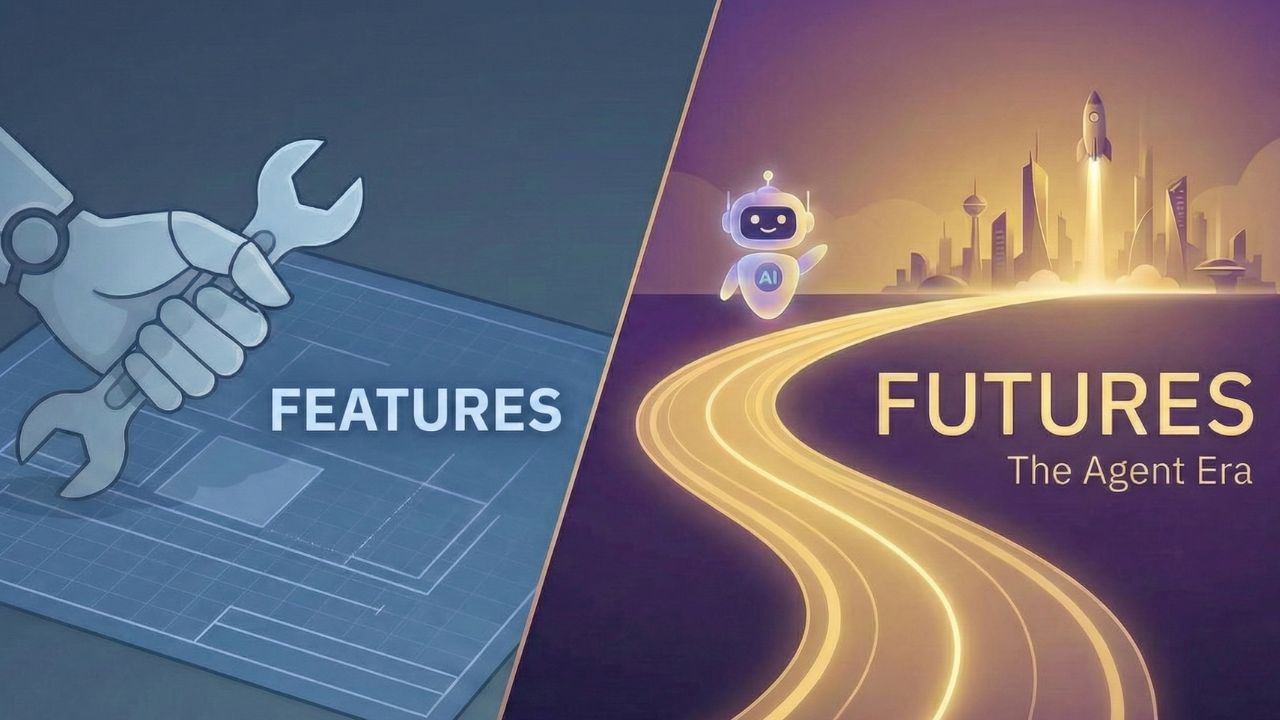
In 2024, Product Marketing was about shouting louder than the competition: "We have Dark Mode!" "We have AI!" "We have better Dashboards!"
In 2026, the feature war is dead. Why? Because Generative AI has commoditized coding. If you launch a unique feature on Monday, your competitor's AI-assisted engineering team can clone it by Friday. If you market based on features, you are marketing a commodity.
To win in the Agent Era, you must shift your strategy to two distinct tracks:
- Selling Futures to Humans (The "Vision" Sale).
- Selling Facts to AI Agents (The "Verification" Sale).
This guide explains how to master this dual-track "Revenue R&D" marketing engine.
Part 1: Selling Futures (The Human Track)
Humans in 2026—especially C-Suite buyers—are overwhelmed by noise. They don't care about your roadmap for next quarter. They care about survival in their own industries.
The "Future-Back" Narrative
Instead of starting with "Here is what our product does today" (Present-Forward), start with "Here is who you become in 2027" (Future-Back).
The Old Pitch: "Our CRM has an AI auto-complete feature for emails." (Boring, replicable).
The Future-Back Pitch: "In 2027, your sales team will no longer type. We are building the 'Zero-Keyboard Sales Floor.' Today, that starts with our auto-complete feature."
Why this works: You aren't selling a tool; you are selling a transformation. However, selling a "Future State" to internal stakeholders is risky. It requires the Negotiation Skills of a Revenue-Carrying PM to align everyone on this long-term bet.
Part 2: Marketing to AI Agents (The Robot Track)
Here is the scary part: Your next buyer might not be human. In 2026, corporate procurement teams use "Purchasing Agents"—AI bots tasked with researching vendors, comparing specs, and verifying compliance.
These bots do not read your beautiful marketing copy. They do not care about your "brand vibe." They care about Structured Data.
The New SEO: "Agent Engine Optimization" (AEO)
To market to an Agent, your product documentation must be machine-readable and brutally transparent.
- API as Marketing: Your API documentation is no longer just for developers; it is your #1 marketing asset. Agents scan it to see if your tool actually integrates with their stack.
- The "Clean" Price: If your pricing page says "Contact Us," the Agent filters you out. Agents prioritize transparent, tier-based pricing they can plug into their budget spreadsheets.
- Security.txt: Agents check for SOC2 compliance and security headers before they even present your name to their human boss.
Part 3: The 2026 Marketing Asset: The "Constitution"
In the age of Agentic AI, "Trust" is the currency. But you can't just say you are trustworthy. You have to prove it.
The new "Whitepaper" is the Product Constitution. This is a public document that defines the "Guardrails" of your AI product:
- What will your AI agent NEVER do? (e.g., "Our Agent will never delete data without human approval.")
- Who owns the data?
- How does it handle bias?
The Strategy: When a human buyer asks, "Is this safe?", you don't send a brochure. You send your Constitution. It is the ultimate differentiator in a market flooded with "Black Box" AI tools.
Part 4: The Unified Strategy
How do you combine these? By realizing they serve different stages of the funnel.
| Funnel Stage | Audience | The Content Strategy |
|---|---|---|
| Discovery | AI Agent | "The Facts: Structured Data, APIs, Compliance Certs." |
| Evaluation | Human (User) | "The Features: UX demos, 'Aha!' moments." |
| Decision | Human (Exec) | "The Future: The 'Future-Back' Vision & The 'Constitution'." |
Conclusion: Orchestrating the Sale
The Product Marketer of 2026 is an Orchestrator. You are conducting a symphony where the strings section (Human Storytelling) plays to the emotions of the C-Suite, while the percussion section (Data & Facts) provides a steady beat for the AI Agents. Stop building features. Start selling the future, and verify it with the facts.
FAQ
Q1: Does "Selling Futures" mean overpromising?
No. It means clearly articulating the destination. You must be honest about where you are on the map today (Features), but you sell the ticket based on the destination (Future).
Q2: How do I test if my site is "Agent Ready"?
Use an LLM (like Gemini or GPT) to "browse" your pricing page and ask it to summarize your tiers. If it hallucinates or fails, your site is not optimized for Agents.
Q3: What replaces the "Case Study"?
The "Live Simulation." Instead of a static PDF case study, show a video of your Agent solving a problem in real-time. "Show, Don't Tell" is the rule.

Sources & References
- "2026 Strategic Content Pillars" – Product Leaders Day India Internal Strategy Doc (2025).
- Ref: Pillar D: "Stop Building Features, Start Selling Futures".
- Ref: Pillar A: "Writing Constitutions and Guardrails".
- Concept: Innosight’s "Future-Back" Strategy Framework.
- Market Trend: Gartner’s Prediction on "Machine Customers" (2025-2028).