Why Your Vibe Coding Strategy Will Fail the Next Audit

A frantic engineering team staring at a SOC 2 audit report with red warning labels, featuring the text Compliance vs Code
  • Compliance is the Real Bottleneck: The technical safety of AI code is secondary to whether it meets strict enterprise compliance frameworks like SOC 2 AI code compliance and ISO 27001 AI coding standards.
  • Provenance is Mandatory: Auditors require a clear chain of custody for every line of code, which is incredibly difficult to provide when an LLM hallucinates entire modules.
  • Regulatory Danger: The EU AI Act source code guidelines are establishing strict new rules about AI-generated software that most development teams are currently ignoring.
  • Policy over Prototyping: Establishing an enterprise vibe coding policy and utilizing an AI code audit checklist is no longer optional for SaaS companies.

Your team is moving faster than ever, and your latest release just passed its internal technical review. But there is a massive storm brewing on the horizon: will your new deployment actually survive your next compliance review?

Your vibe-coded module passed review — but will it pass your SOC 2 auditor? Engineering leaders are finally waking up to the fact that asking "is vibe coding safe for production code" is completely the wrong question.

It isn't just about whether the application compiles; it is about whether you can legally and structurally defend it.

If your organization is stumbling blindly into AI-assisted development, you are on a fast track to triggering severe vibe coding production disasters.

The Core Debate: Is Vibe Coding Safe for Production Code?

When you ask if AI-generated logic is safe for production, you are likely only thinking about uptime and bug rates. The real danger lies in the lack of code provenance.

When an engineer writes a function, there is a clear cognitive trail and intent. When an AI "vibes" a 500-line microservice, that trail disappears.

This loss of traceability is exactly why some compliance officers are hitting the brakes. If you want to understand the raw, quantified technical risks before tackling the legal ones, review the latest vibe coding security vulnerabilities study.

The SOC 2 and ISO 27001 Reality Check

Modern software companies live and die by their certifications. A SOC 2 Type II audit doesn't just check if your code works; it verifies your processes.

  • Change Management: How do you prove that a human thoroughly reviewed the AI's output before merging?
  • Access Controls: Did the AI model itself have unauthorized access to sensitive proprietary codebase context during generation?
  • Vulnerability Patching: When a zero-day drops, can you quickly identify which AI-generated modules contain the vulnerable pattern?

If your enterprise vibe coding policy cannot answer these three questions definitively, your auditor will flag your change management controls as deficient.

What the EU AI Act Says About Source Code

Regulatory bodies are not waiting for the tech industry to self-regulate. The EU AI Act source code provisions are forcing companies to rethink their entire delivery pipeline.

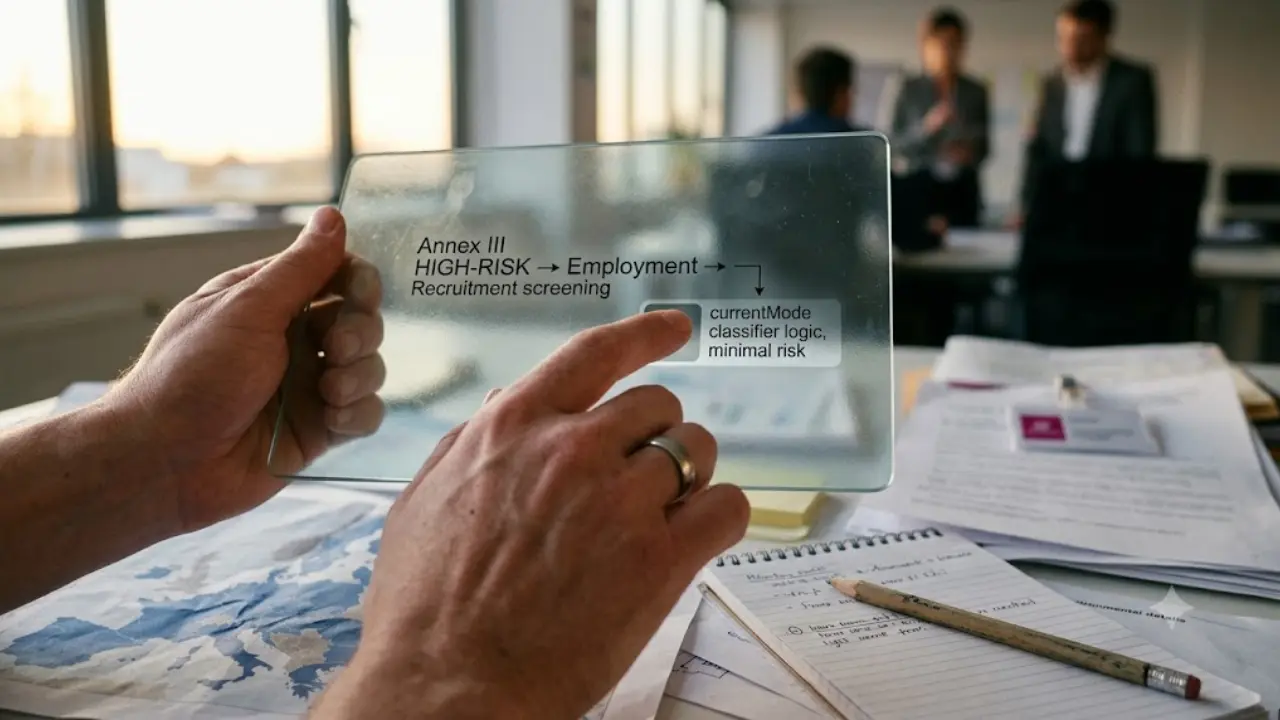
Under these new frameworks, certain types of AI-generated systems face immense scrutiny. If your application falls into a "high-risk" category, the AI-generated logic within it must be fully explainable.

"Vibe coding" is the antithesis of explainability. Relying on an LLM's black-box generation for critical financial or medical routing logic is a direct violation of these emerging global standards.

The Governance Checklist for Enterprise Teams

You do not have to ban AI tools, but you must govern them. An effective AI code audit checklist requires a fundamental shift in how your CI/CD pipeline operates.

  1. Mandate Human Sign-Off: Every PR generated by an AI must be explicitly tagged and require dual human approval.
  2. Implement Static Analysis Restrictions: AI-generated code must pass stricter static application security testing (SAST) thresholds than human code.
  3. Establish an Approved Tool Registry: Developers cannot bring their own unvetted AI tools. Procurement and security must approve the specific LLM enterprise tier.
  4. Document the Prompts: The architectural intent (the "vibe") used to generate the code should be stored in the commit metadata for future auditability.

About the Author: Sanjay Saini

Sanjay Saini is a Senior Product Management Leader specializing in AI-driven product strategy, agile workflows, and scaling enterprise platforms. He covers high-stakes news at the intersection of product innovation, user-centric design, and go-to-market execution.

Connect on LinkedIn

Gather feedback and optimize your AI workflows with SurveyMonkey. The leader in online surveys and forms. Sign up for free.

SurveyMonkey - Online Surveys and Forms

Frequently Asked Questions (FAQ)

Is vibe coding safe for production code in SaaS apps?

It is not inherently safe without strict governance. While it accelerates initial development, SaaS companies must implement rigorous automated testing, manual code reviews, and robust CI/CD pipelines to ensure the AI-generated logic does not introduce subtle security flaws or performance regressions.

Can vibe-coded code pass a SOC 2 Type II audit?

Yes, but only if your change management processes are flawless. You must be able to prove to the auditor that all AI-generated code underwent strict human review, vulnerability scanning, and testing before being merged into the main branch.

What percentage of vibe-coded projects fail at the staging gate?

While internal metrics vary by company, teams lacking a mature AI code audit checklist frequently see a high percentage of AI-assisted projects fail staging due to unhandled edge cases, architectural drift, and security regressions that the AI failed to anticipate.

Which industries have banned AI-generated code outright?

Highly regulated sectors, particularly defense contracting and certain legacy banking institutions, have temporarily banned or heavily restricted AI-generated code. They cite concerns over intellectual property contamination, lack of code provenance, and strict federal compliance mandates.

What does the EU AI Act say about AI-generated source code?

The EU AI Act introduces stringent transparency and explainability requirements. If AI-generated source code is used in a high-risk system, the developers must be able to fully explain the logic and ensure it does not violate fundamental rights or safety standards.

How do you document AI-coded modules for compliance?

You must document the origin of the code within the commit history. Best practices involve tagging pull requests with the specific AI tool used, storing the foundational prompts as architectural decision records (ADRs), and requiring documented human sign-off.

Is vibe coding acceptable under ISO 27001 controls?

It can be acceptable, provided it aligns with your established Secure Software Development Life Cycle (SSDLC). ISO 27001 requires you to identify and mitigate risks; therefore, your enterprise vibe coding policy must explicitly address the risks of LLM hallucinations.

What insurance carriers exclude AI-generated code from coverage?

Cyber liability insurance carriers are increasingly scrutinizing AI coding practices. Some providers are beginning to draft policy exclusions or mandate higher premiums if a company cannot demonstrate strict governance and security testing of AI-authored production code.

How do regulated industries (fintech, healthtech) approach vibe coding?

Fintech and healthtech approach it with extreme caution. They typically restrict AI use to generating boilerplate or test scripts, keeping AI far away from core algorithmic logic, PII handling, and financial transaction routing to maintain strict compliance.

What's the right governance model for vibe coding inside an enterprise?

The right model includes a centralized enterprise vibe coding policy. It requires using only approved enterprise-tier AI tools with zero-data-retention agreements, enforcing mandatory human code reviews, and implementing aggressive automated security scanning on every AI-assisted pull request.