« As detailed in our master guide: The 2005 Design Process That Still Beats Agile
Cut Discovery Time 40% With 4 Key Stages
- Added expanded benchmarking data for cross-functional agile teams.
- Included tactical strategies for leveraging automation to speed up early-stage qualitative synthesis.
- Clarified exact deliverables required to successfully pass the Define stage-gate without triggering executive friction.
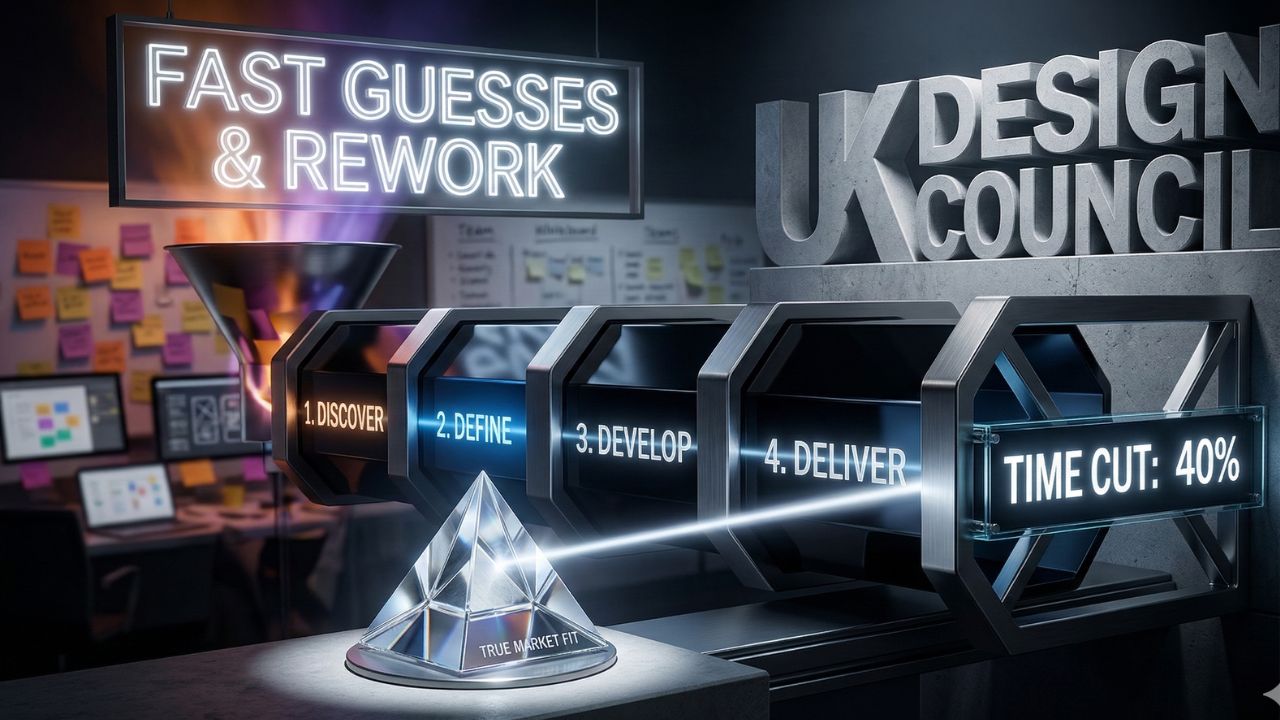
- The Core Methodology: Success relies on mastering the strict boundaries of the double diamond discover define develop deliver lifecycle.
- The Economic Benefit: Properly executed stages cut total discovery time by 40% and actively prevent costly engineering rework down the line.
- Compliance Alignment: Rigorous phase management maps directly to strict NIST IR 8332 Usability Guidelines.
- The Immediate Fix: Stop blurring the lines between exploring the problem space and committing to the solution space.
Your team is likely bleeding expensive engineering hours because they aren't actually defining the problem; they are just guessing faster.
Rushing the double diamond discover define develop deliver stages guarantees failure and creates an endless loop of costly rework. Too many product managers mistake motion for progress, shipping code before the root cause of user friction is fully understood.
By mastering the specific boundaries of these four stages, you can lock in true product-market fit and slash your overall discovery time by 40%. The framework provides a structured approach to problem-solving, forcing teams to diverge (think broadly) and converge (focus narrowly) twice before a single line of production code is written.
Mastering the Mechanics of the 4 D's
The product development lifecycle is often incorrectly treated as a linear, check-the-box list. You gather a few requirements, draft a wireframe, and throw it over the fence to the engineering team.
In reality, sustainable innovation requires a structured expansion and contraction of ideas. When you try to optimize the double diamond discover define develop deliver stages, you must apply rigorous stage-gates. Each phase requires a different mindset, different artifacts, and a different set of success metrics.
Stage 1: Discover (Divergent Problem Space)
The goal here is not to find a solution. The goal is to deeply explore the user's operational reality without bias. You are casting a wide net to capture all potential friction points.
During the Discover phase, product managers must engage in contextual inquiry and ethnographic research. This means watching users struggle with their current workflows, analyzing support ticket trends, and mapping the real-world customer journey. If you attempt to draft a feature list or write a single line of code here, you have already failed.
Modern teams are now utilizing advanced product discovery with AIto synthesize thousands of qualitative feedback points in minutes, highlighting patterns that human analysts might miss. To assist your team in formalizing these early hypotheses manually, we recommend utilizing the classic Strategyzer Test Card template.
Stage 2: Define (Convergent Problem Space)
This is where you synthesize your massive pile of qualitative data into a singular, undeniable truth. You take the scattered insights from the Discover phase and narrow them down to the core issue.
You must actively discard 90% of what you learned in the Discover phase to focus entirely on the highest-frequency, highest-impact pain point. This contraction requires discipline and the ability to project influence without authoritywhen executives inevitably attempt to inject pet projects into the scope.
Never move into the Develop phase without a stakeholder-approved Problem Statement. Treat this document as an unbreachable firewall. If the problem isn't clearly defined using hard behavioral data, your subsequent prototype is fundamentally useless.
Stage Optimization Metrics
To truly cut discovery time, you must measure the efficiency of your stage transitions. You cannot optimize a process you do not track.
Below is a strict benchmark guide for enterprise teams to evaluate their performance across the four lifecycle stages.
| Stage | Primary Artifact | Success Metric | Compliance Tie-In |
|---|---|---|---|
| Discover | Current-State Journey Map | Volume of validated, undocumented pain points surfaced. | NIST IR 8332 |
| Define | Data-Backed Problem Statement | Speed of stakeholder sign-off and consensus. | NIST IR 8332 |
| Develop | High-Fidelity Tested Prototype | Defect rate and task completion speed in user testing. | NIST IR 8332 |
| Deliver | Shipped Code Increment | Adoption rate and reduction in related support tickets. | NIST IR 8332 |
Stage 3: Develop (Divergent Solution Space)
Now that the exact problem is locked in place, your engineering and design teams can safely innovate. You open the funnel back up to explore multiple ways to solve the single problem defined in Stage 2.
This stage demands rapid prototyping, multidisciplinary collaboration, and aggressive usability testing. You are actively trying to break your own ideas. Leveraging modern AI product owner toolscan drastically reduce the administrative burden of writing test scripts and organizing user feedback sessions here.
The faster you mathematically invalidate a bad prototype, the faster you secure your return on investment. Do not commit to a single solution until the prototype data proves it works.

Stage 4: Deliver (Convergent Solution Space)
This final stage is about rigorous execution. You have validated the prototype; now you must build the production-ready software. It involves CI/CD pipelines, phased rollouts, strict quality assurance, and go-to-market alignment.
Delivery is not just about shipping the code and celebrating. Whether you utilize a traditional enterprise model or a hybrid PLG SLG product strategy model, delivery is about establishing a quantitative feedback loop. You must actively monitor real-world telemetry and revenue performance against your initial Problem Statement.
The Hidden Trap: What Most Teams Get Wrong about the 4 Stages
The most fatal mistake B2B development teams make is disguised as "agile efficiency." They attempt to move fast by treating the four stages as overlapping suggestions rather than strict sequential requirements.
This hidden gap in your UX roadmap is exactly why major product launches fail. When teams overlap the Define and Develop stages, they experience immediate and uncontrollable scope creep. Engineers start building technical architecture for a problem that the business side is still actively morphing.
To prevent this, you must weaponize the word "No." If an executive demands a brand new feature during the Develop phase that wasn't previously validated in the Define phase, you must force that request back to the beginning of the Discover cycle. Tracking these enforcement boundaries via a success metrics dashboardprovides the objective data required to hold leadership accountable to the process.
Frequently Asked Questions
What specific actions happen in the discover phase?
The discover phase focuses on wide-net qualitative research. Actions include conducting user interviews, shadowing live customer workflows, analyzing support ticket trends, and mapping the current-state user journey to uncover unarticulated pain points before any solutions are considered.
How do you define the right problem using data?
You synthesize qualitative discovery research into quantitative behavioral data. Look for the highest-frequency, highest-friction pain points. The right problem is objectively backed by usability metrics, clearly documented, and strictly bounded by measurable user impact rather than executive intuition.
What does develop mean in the context of this framework?
In this framework, develop means iterating on potential solutions through low-fidelity to high-fidelity prototyping. It involves multidisciplinary teams running rapid usability tests to mathematically validate which specific design best solves the strictly defined problem statement.
How do you ensure a successful deliver stage?
A successful deliver stage requires strict adherence to QA, phased feature rollouts, and establishing robust post-launch analytics. You ensure success by tracking adoption rates and verifying that the shipped increment directly solves the problem defined in the earlier stages.
Which of the 4 D's is the most resource-intensive?
The Develop stage is typically the most resource-intensive. It requires heavy collaboration between design, engineering, and product management to build, test, scrap, and rebuild prototypes until a viable, technically feasible solution is fully validated.
How do you allocate budget across the 4 stages?
Budget should be front-loaded into Discover and Define to mitigate downstream risks. While Develop consumes high engineering costs, underfunding the initial problem-space stages guarantees that those expensive engineering hours will be wasted on building the wrong features.
What metrics track success in the define stage?
Success metrics in the define stage include the speed of stakeholder consensus on the core problem, the measurable reduction of assumed scope, and the creation of a strictly scoped, data-backed Problem Statement artifact that governs the remainder of the project.
How do stakeholders align during development?
Stakeholders align during development through mandatory, formal prototype reviews. By demonstrating usability test results rather than theoretical features, teams can force alignment based on actual user behavior and technical feasibility, neutralizing subjective opinions.
What are common bottlenecks in the delivery stage?
Common bottlenecks include technical debt discovered late, poor release management, and a lack of go-to-market alignment. Delivery stalls when engineering is forced to patch rushed architecture or when sales teams aren't trained on the newly shipped functionality.
How do you restart the cycle after delivery?
You restart the cycle by feeding quantitative analytics and user feedback from the shipped product directly back into a new Discover phase. Delivery is never the end; it serves as the baseline data for your next iteration of continuous improvement.
Next Steps:
Are you ready to stop burning capital on bad assumptions and rushed execution?
Would you like me to generate a strict checklist for your next Discover phase to ensure your product team captures the exact behavioral data required to build a bulletproof problem statement?
Sources & References:
- National Institute of Standards and Technology. NIST IR 8332: Usability Guidelines for enterprise software development.
- The UK Design Council. The Double Diamond Strategy and Execution Framework.
- Strategyzer. Testing Business Ideas: A Field Guide for Rapid Experimentation.