« Back to Pillar Page: The AI Product Manager Guide
5 AI Agents Every Product Manager Needs in 2026 (Beyond ChatGPT)
What's New in This Update (May 2026)
- Updated vendor comparisons reflecting Anthropic's Claude 4.6 release and its impact on autonomous code reasoning.
- Added explicit API token cost warnings for Jira Product Discovery AI following Atlassian's Q1 pricing restructure.
- Expanded the "Synthetic Users" section to include Kraftful's new dynamic persona weighting mechanisms.
Key Takeaways
- Agency replaces output: We no longer need chat windows to generate text; we need background processes that identify data anomalies, update tickets, and correlate cross-functional documentation.
- Context is king: Generic LLMs hallucinate product requirements. Integrating deeply contextual workspace agents (like Notion AI and ClickUp Brain) is the primary defense against bad data.
- The rise of the synthetic user: Waiting two weeks for qualitative user interviews creates severe validation bottlenecks. PMs are bridging this gap using AI-simulated focus groups built on vast repositories of historic feedback.
Introduction: From "Tools" to "Teammates"
The SaaS product management stack has undergone a fundamental architectural shift. We are no longer just licensing software to log bug tickets or store static text documents; modern product teams are effectively hiring autonomous AI agents for business. The crucial distinction here is agency. While a passive tool sits idle waiting for human interaction—like ChatGPT waiting for your prompt—an active agent observes your data pipelines, anticipates bottlenecks, and executes actions independently.
For the modern Product Manager, career longevity relies heavily on mastering the AI product manager playbook. Success is no longer measured by how fast you manually format a user story. Instead, execution velocity depends on how effectively you orchestrate a specialized team of AI agents to handle automated sprint planning, customer feedback analysis, and cross-platform data correlation. This guide moves past the basic utility of broad language models to explore the highly specialized agents redefining top product management software in 2026.
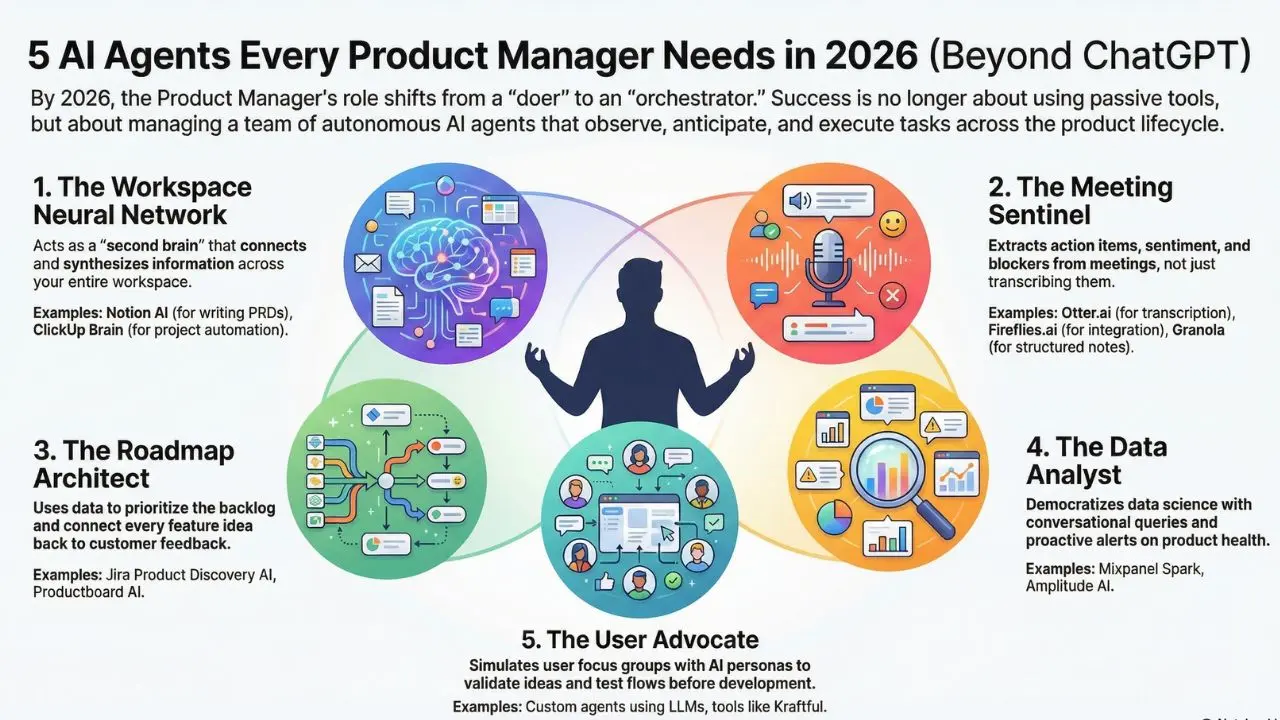
1. The Workspace Neural Network: Notion AI vs. ClickUp Brain
The foundation of any modern product team is a connected "Second Brain" that does not merely act as a file repository, but actively synthesizes internal knowledge. The battle for this connected workspace is fierce, with the Notion AI vs ClickUp Brain debate representing two entirely different philosophies of agentic assistance.
Notion AI: The Contextual Writer
Notion has aggressively evolved its platform from a flexible wiki into a context-aware semantic agent. Its primary strength lies in generative AI for product requirements. Because it natively indexes your entire workspace via vector search, Notion AI can instantly draft a comprehensive Product Requirements Document (PRD). It accomplishes this by silently pulling context from disparate sources: an engineering spec sheet, three different meeting transcripts, and a parsed user research database.
You no longer copy and paste URLs. You simply state, "Draft a PRD for the new checkout flow based on the Q2 user interview database and last week's engineering sync."
Best For: Complex knowledge management, zero-hallucination PRD writing, and unifying fragmented team wikis.
ClickUp Brain: The Operational Project Manager
If Notion is your technical writer, ClickUp Brain is your aggressive operational manager. This autonomous AI agent connects tasks, documents, and individual contributors to ensure delivery velocity. It excels at parsing operational reality rather than just text.
One of its strongest features is the "AI Standup." ClickUp Brain can autonomously summarize exactly what your backend engineers worked on yesterday by cross-referencing their Git commits, pulled PRs, and task status updates. It also handles automated sprint planning by analyzing historical velocity data to predict team bottlenecks before sprint commitment.
Best For: Hard task automation, generating operational visibility reports, and keeping distributed engineering teams aligned without endless meetings.
Read Next: Operating a team composed of both humans and algorithms requires entirely new soft skills. Read our guide on how to manage non-human team members.
2. The Meeting Sentinel: Otter vs. Fireflies vs. Granola
Verbal conversations are the raw, unstructured data of product management. In 2026, relying on manual note-taking is a critical failure of resource allocation. An AI meeting assistants comparison reveals that modern agents do much more than transcribe; they parse sentiment, assign accountability, and identify structural blockers automatically.
- Otter.ai: Still the heavyweight standard for transcription accuracy and speaker diarization in loud, overlapping enterprise environments. It serves as the baseline "perfect memory" for dense stakeholder interviews where verbatim accuracy is legally or structurally necessary.
- Fireflies.ai: Distinguishes itself through deep API integration. It acts as an integration router, pushing structured notes directly into your CRM (like Salesforce) or updating statuses on your Jira board. This effectively automates the "post-meeting admin" tax, making it a critical asset for correlating sales calls with customer feedback analysis.
- Granola: The breakout star for qualitative product research. Granola focuses on "structured intelligence." Instead of dumping a massive, unreadable raw transcript, it forces meeting data into specific, customizable templates. If you are running a design critique or a user interview, Granola formats the output specifically for those use cases, making it an indispensable companion to AI tools for user story mapping.
3. The Roadmap Architect: Jira Product Discovery & Productboard AI
Bridging the gap between high-level product strategy and granular engineering execution requires AI roadmap tools capable of handling massive data throughput without losing the strategic narrative.
Jira Product Discovery AI
Atlassian has embedded its intelligence deep into Jira Product Discovery. This agent acts as a ruthless prioritization engine. It scores backlog ideas based on dynamic, multi-variable impact vs. effort matrices. More importantly, it can ingest thousands of raw Jira tickets, support requests, and bug reports to identify hidden recurring themes. When a stakeholder asks, "Why are we building this specific feature next?", Jira Product Discovery provides a mathematically confident, data-backed answer.
Productboard AI
Productboard AI shines in closing the dangerous gap between engineering and the customer. It functions as an aggregation funnel, pulling unstructured feedback from Slack channels, Zendesk support tickets, and direct emails. Using advanced Natural Language Processing (NLP), it auto-links specific, visceral customer quotes directly to your feature ideas. This creates a living, breathing roadmap where every single feature ticket is traceable back to the raw "Voice of the Customer."
4. The Data Analyst: Mixpanel Spark vs. Amplitude AI
Product managers historically bottlenecked at the data science team. Waiting three days for a custom SQL query to validate a simple drop-off rate is no longer acceptable. The Mixpanel vs Amplitude AI feature arms race represents the total democratization of data analysis.
- Mixpanel Spark: Focuses heavily on conversational, natural-language querying. You can type, "Show me the funnel drop-off rate for the new iOS signup flow in India over the last 14 days, split by device type," and Spark generates the exact visualization instantly. It replaces the junior data analyst role for ad-hoc queries.
- Amplitude AI: Takes a more predictive, proactive stance. Rather than waiting for you to ask a question, it uses historical behavioral data to actively suggest which user cohorts are likely to churn or upgrade. For a PM, this means the agent pushes an alert to your Slack stating, "Users who fail to complete onboarding step 3 within 24 hours have an 80% churn probability." This enables rapid, targeted intervention.
5. The User Advocate: Synthetic Users & Feedback Analyzers
Finally, the most radical shift in the "Agentic" PM stack is the deployment of software that simulates human behavior. Customer feedback analysis tools have evolved past sentiment scoring to include active "Synthetic Users."
Platforms like Kraftful, or custom agents built securely on top of frontier LLMs like Claude and Gemini, allow product teams to spin up simulated focus groups. By feeding the agent highly detailed user personas—including demographic data, past support tickets, and specific pain points—you can run proposed user story maps against these synthetic users.
The synthetic agent will actively flag edge cases, confusing UI text, or logical friction points in your flow before a single line of code is written. While it does not replace the necessity of speaking to real humans, this "Infinite Feedback Loop" drastically reduces validation cycle times. When you finally put the prototype in front of a real user, you are testing highly refined, high-quality hypotheses rather than catching basic structural errors.
Deep Dive: Want to build your own automated testing cohort? Read our complete technical guide on how to integrate synthetic users into your product testing loop.
The Strategic PM Perspective
When evaluating whether AI is the future of product management, adopting autonomous agents is the first step.
However, to truly scale these capabilities, transitioning your tech stack requires a fundamental shift from legacy feature-factory roadmaps to an AI project to product funding methodology. If you are building software that autonomous agents will eventually buy or consume on behalf of humans, you must also understand what B2A (Business-to-Agent) architecture means.

Frequently Asked Questions (FAQ)
Q1: What is the difference between an AI tool and an AI agent?
An AI tool is passive; it waits for your manual input (like ChatGPT waiting for a prompt). An autonomous AI agent actively works toward a goal, observing data and executing actions (such as monitoring product dashboards and auto-generating tickets) without constant human oversight.
Q2: Can AI agents handle sensitive product data securely?
Yes, but vendor selection is critical. Enterprise-grade agents in the top product management software of 2026 feature zero-retention policies. This ensures your proprietary roadmaps and customer data are never used to train public language models.
Q3: Which AI meeting assistant is best for user interviews?
In a 2026 Otter vs. Fireflies vs. Granola comparison, Granola is typically preferred for qualitative user interviews due to its structured intelligence templates. Fireflies excels in B2B environments where pushing synced data directly to a CRM or Jira board is paramount.
Q4: Will these agents replace the Product Owner role?
No. While agents handle automated sprint planning, backlog refinement, and ticket generation, the Product Owner's role shifts toward strategic governance. You still dictate the "why" and validate the agent's logic, while the agent executes the "how."
Related Resources
- The AI Product Manager: The Complete Guide to GenAI, Agents & Automation – The pillar page overviewing the entire landscape.
- ChatGPT vs. Claude vs. Gemini: Which is Best for PRD Writing? – Deep dive into the LLMs powering these agents.
- The "Agentic" PM: How to Manage Non-Human Team Members – A guide on how to operationalize these tools in your team.
- How to Build a Synthetic User Focus Group Using AI – Learn to build your own custom research agents.