ChatGPT vs. Claude vs. Gemini: Best LLM for Product Managers (2026)
By Sanjay Saini | Last Updated: May 14, 2026
- Updated context window benchmarks reflecting Gemini 1.5 Pro's 2-million token capacity.
- Added detailed analysis of OpenAI's o1 reasoning model for complex logical mapping.
- Expanded the section on Enterprise Data Privacy and zero-retention clauses.
Introduction: The AI Tooling Matrix
Treating all Large Language Models (LLMs) as interchangeable chatbots is a strategic error. You wouldn't use Jira to design a user interface, and you shouldn't use a creative writing model to run a predictive churn analysis.
As we navigate 2026, the generalized AI assistant has fragmented into highly specialized domains. Product managers must construct a comprehensive AI product management stack, deploying specific foundational models for specific phases of the product lifecycle.
This guide benchmarks the three dominant players—ChatGPT, Claude, and Gemini—against the tasks that consume a product manager's week: writing Product Requirement Documents (PRDs), synthesizing qualitative user feedback, analyzing quantitative product telemetry, and rapidly prototyping new features.
1. Claude 3.5 Sonnet: The PRD Wordsmith
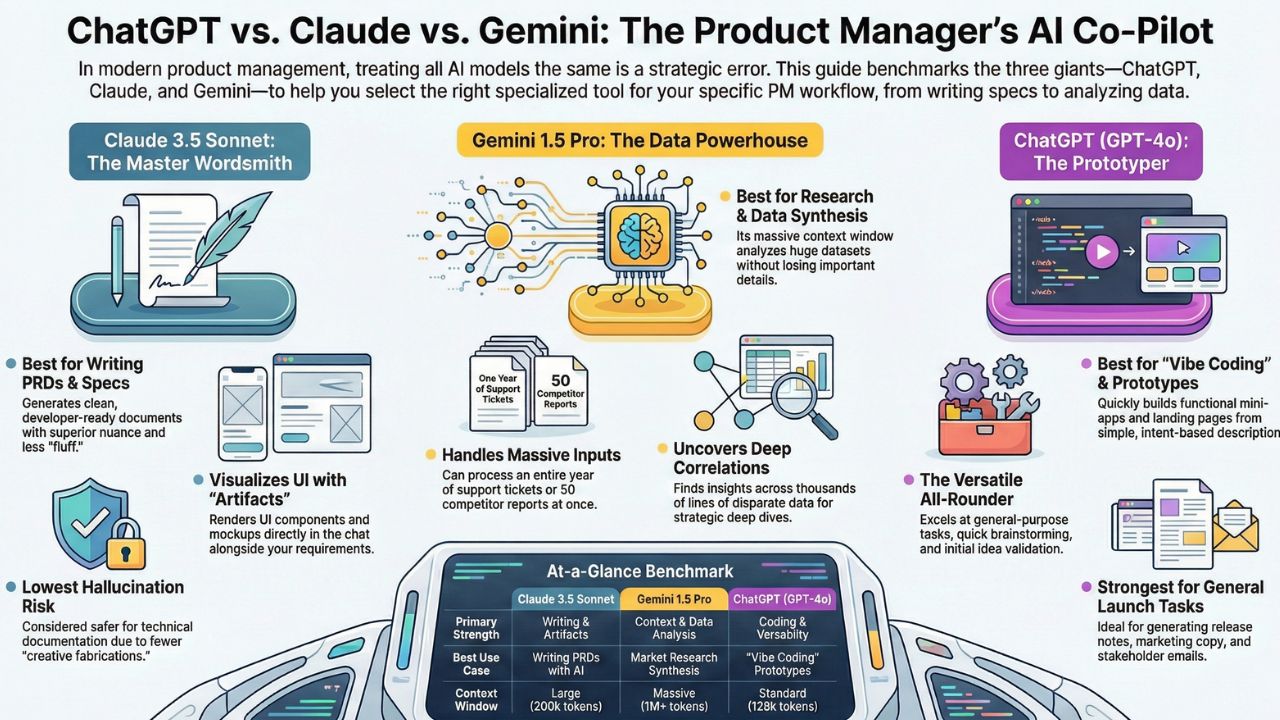
When evaluating ChatGPT vs Claude 3.5 Sonnet for technical writing, the consensus among engineering leaders is clear: Claude generates significantly better documentation.
Why Claude Dominates PRD Writing
Claude possesses a distinct, less verbose personality. While ChatGPT often defaults to enthusiastic, marketing-heavy language full of bullet points and emojis, Claude defaults to dry, structural clarity. It intuitively understands the difference between a high-level user story and a strict functional requirement.
- The Projects Feature: The Claude Projects feature allows PMs to upload an entire knowledge base—such as brand voice guidelines, API swagger documentation, and past PRDs—into a dedicated workspace. This form of context engineeringensures the AI generates requirements that align perfectly with your company's existing technical architecture.
- Artifacts for UI Prototyping: Claude Artifacts transforms the platform from a text generator into a visual workspace. When you describe a feature, Claude does not just outline it; it renders an interactive React component or a visual mockup directly in a side panel. You can instantly validate the UX alongside the written requirement.
- Low Hallucination Risk: In rigorous 2026 benchmarks, Claude 3.5 Sonnet consistently exhibits lower rates of "creative fabrications" compared to its peers, making it the safest choice for drafting technical specifications that engineers will rely on.
The Verdict: Claude 3.5 Sonnet is the undisputed champion for writing clean, developer-ready PRDs and structural documentation.
Actionable Resource: Ready to start drafting? Grab our 50+ Copy-Paste Prompts for Product Managersto feed directly into Claude.
2. Gemini 1.5 Pro: The Data Synthesizer
If Claude acts as your lead technical writer, Gemini operates as your lead user researcher. In the battle of Gemini Advanced vs ChatGPT for massive data analysis, Google's native ecosystem integration and architectural scale provide a distinct advantage.
The 2-Million Token Advantage
Gemini 1.5 Pro boasts a staggering 2-million token context window. This "infinite memory" capability fundamentally alters how PMs approach qualitative research.
- Massive Data Ingestion: You can upload 50 hours of recorded customer interviews, a quarter's worth of Zendesk support tickets, and an entire PDF competitor report in a single prompt.
- Synthetic Focus Groups: By feeding Gemini vast amounts of real user feedback, you can instruct it to adopt the persona of your target demographic, allowing you to run a synthetic user focus groupto test feature ideas before spending a dime on engineering.
- Workspace Integration: Gemini seamlessly pulls data directly from Google Docs, Sheets, and Drive, eliminating the friction of manual data export and upload.
The Verdict: Gemini is the superior tool for synthesizing massive datasets, analyzing deep qualitative research, and querying sprawling document repositories.
3. ChatGPT (GPT-4o & o1): The Prototyper
ChatGPT remains the most versatile foundational model on the market. While it may occasionally lose to Claude in writing nuance or Gemini in sheer memory size, it excels in rapid execution and complex logical reasoning.
Mastering "Vibe Coding"
"Vibe coding" is the 2026 practice of generating functional software by describing the "vibe" or business intent, rather than writing syntax. ChatGPT, specifically GPT-4o, excels at this rapid prototyping.
- Zero-to-One Validation: A PM can instruct ChatGPT: "Build a single-page HTML/JS prototype of a B2B checkout flow that feels like Stripe, featuring a pricing toggle and a dynamic discount calculator." ChatGPT will output the functional code in seconds, allowing you to test interactions before engaging your design team.
- Advanced Data Analysis: While Gemini handles massive unstructured text well, ChatGPT's Advanced Data Analysis is unmatched for structured quantitative data. Upload a messy CSV of user engagement metrics, and ChatGPT will write and execute native Python scripts to clean the data, run regression analyses, and output formatted charts.
- Deep Reasoning (o1 Model): For complex product logic—such as mapping out multi-variant pricing tiers or establishing complex permission matrices—the OpenAI o1 model spends dedicated "thinking tokens" to work through the logic step-by-step, significantly reducing logical errors.
The Verdict: ChatGPT is the ultimate generalist, ideal for vibe coding, quantitative data scripting, and complex logical mapping.
4. Enterprise Privacy: Protecting the Roadmap
You cannot paste proprietary product roadmaps, unreleased financial metrics, or raw customer data into a public, free-tier LLM. Doing so actively trains the public model on your company's intellectual property, presenting a massive compliance failure.
To use these tools safely, product leaders must advocate for enterprise-grade subscriptions. ChatGPT Enterprise, Claude for Work (Team/Enterprise), and Google Workspace Gemini all include strict zero-retention policies. This guarantees that your data, prompts, and uploaded documents are isolated and explicitly excluded from future model training runs.
Summary Comparison Table: 2026 Benchmark
| Feature Category | Claude 3.5 Sonnet | Gemini 1.5 Pro | ChatGPT (GPT-4o / o1) |
|---|---|---|---|
| Primary PM Strength | Technical Writing & UI Artifacts | Massive Context & Deep Research | Prototyping & Python Scripting |
| Best Use Case | Writing PRDs, API Specs, Epics | User Interview Synthesis, Competitor Scrapes | Vibe Coding, CSV Data Analytics |
| Context Window Limit | 200,000 tokens | 2,000,000 tokens | 128,000 tokens |
| Hallucination Risk | Low (Best for exact specs) | Low-Medium (Can drift on long text) | Medium (Requires tight prompting) |
| Unique Feature | Artifacts & Projects | Native Google Drive Ingestion | o1 Reasoning & Advanced Data Analysis |
Next Steps: Once you master the foundational models, it is time to automate them. Learn how to connect these LLMs to autonomous workflows in our guide to multi-agent orchestration workflows.
Frequently Asked Questions (FAQ)
Q1: Which AI model has the lowest hallucination rate in 2026?
Based on 2026 benchmarks, Claude 3.5 Sonnet maintains a slight edge in reducing fabrications, making it the safest model for technical documentation, PRDs, and API specs. OpenAI's o1 model is a close second when utilizing its extended reasoning tokens to fact-check its own logic before outputting text. If you are struggling with bad data, reviewing a strong hallucination detectionstrategy is critical.
Q2: Is Gemini Advanced better than ChatGPT for data analysis?
Gemini 1.5 Pro excels at synthesizing massive, unstructured datasets due to its 2-million token context window. You can feed it dozens of PDFs and ask for overarching themes. However, ChatGPT (GPT-4o) with Advanced Data Analysis remains superior for running Python scripts to generate charts, pivot tables, and statistical regressions on structured CSV files.
Q3: Can I use these tools for proprietary company data?
You can use them safely only if you upgrade to the Enterprise or Team tiers. ChatGPT Enterprise, Anthropic's Claude for Work, and Google Workspace Gemini all include strict "zero-retention" clauses, meaning your proprietary data is explicitly excluded from their future training models.
Q4: What is "Context Engineering" in relation to these tools?
Context engineering replaces basic prompt engineering. It is the architectural practice of curating the exact background data (brand voice, past PRDs, Jira tickets, design system rules) the AI needs to generate accurate output. Features like Claude Projects are built specifically for context engineering, allowing you to anchor the model to your specific reality.
Q5: Which model is best for Vibe Coding?
ChatGPT (specifically GPT-4o and o1) currently leads for "vibe coding"—the process of generating rapid, functional prototypes using natural language intent rather than strict syntax. Claude 3.5 Sonnet with Artifacts is a very close competitor for frontend React/HTML generation, allowing you to view the UI side-by-side with the code.

Related Resources
- The AI Product Manager: The Complete Guide to GenAI – Return to the main pillar page.
- The Best AI Tools for Project Managers – Find the right stack for operational delivery.
- 5 AI Agents Every Product Manager Needs in 2026 – Move beyond chatbots to autonomous agents.
- 50+ Copy-Paste Prompts for Product Managers – Get the specific prompts to make these models work for you.