Multi-Agent Orchestration News Vendors Bury in PR
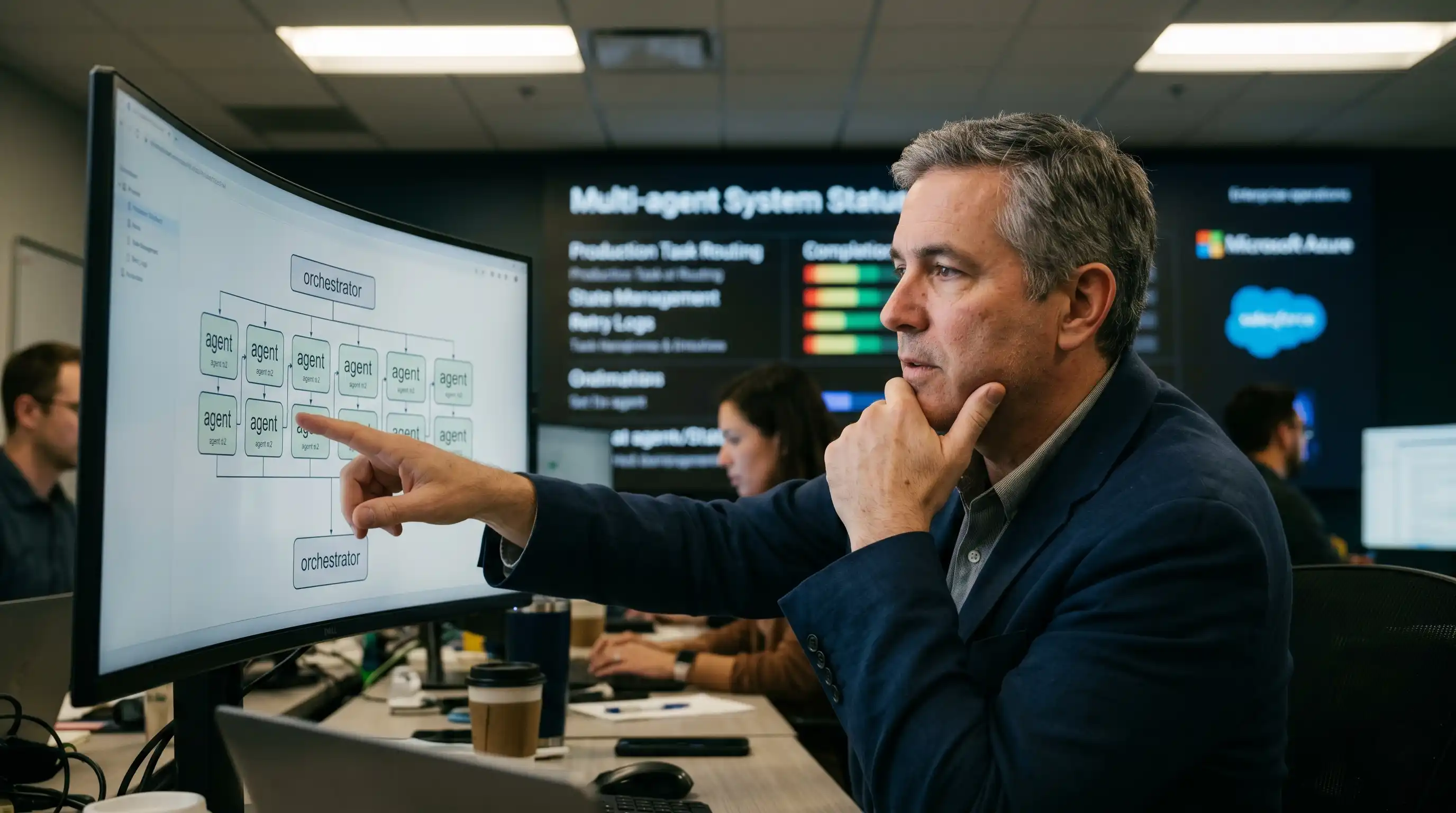
- Orchestration vs. Single Agents: Orchestration is the vital coordination layer that manages several specialized agents to complete full workflows reliably.
- The Launch-vs-Adoption Gap: Overwhelming vendor PR obscures the fact that only 11-14% of enterprise agent pilots successfully reach scale in production.
- How to Filter the Noise: Defuse headlines by asking if the product is GA, has independent production users, and genuinely coordinates agents.
- The 5 Beats to Track: Focus exclusively on Platform Launches, Enterprise Deployments, Big Tech Moves, Framework Updates, and Interop Protocols.
- Real Roadmap Signals: True roadmap shifts only come from named deployments, multi-vendor protocols, or breaking framework changes.
Every week another vendor declares the orchestration problem solved, and your feed fills with launch posts that all sound identical. Tracking multi-agent orchestration news requires separating facts from hype.
By the time a "2026 roundup" reaches you, half of it is already stale and the other half is marketing. The result: PMO and delivery leaders making roadmap calls on press releases instead of signal.
This desk exists to fix that. It tracks multi-agent AI orchestration news the way an analyst would—separating what genuinely shifts an enterprise roadmap from what is simply a vendor restating its catalogue.
Below is how to read this space, the five beats we follow, and the one filter that tells launch noise from production reality.
Executive summary: read orchestration news in 30 seconds
Most orchestration headlines fall into one of five beats. Each beat carries a different signal weight for someone who has to make a delivery decision—and knowing the weight is how you stop reacting to every announcement.
| News beat | What it usually is | Signal weight for delivery leaders |
|---|---|---|
| Platform launches | New or rebranded orchestration product | Low – until GA + independent production proof |
| Enterprise deployments | A named company runs agents at scale | High – adoption is the real signal |
| Framework updates | LangGraph / CrewAI / Agno release | Medium – watch for breaking changes |
| Big Tech internal moves | Leaked tools (e.g. Agent Smith) | Medium – direction, not availability |
| Interop/protocols | A2A, MCP standard developments | High – bets here are expensive to reverse |
The one-line filter: weight adoption over announcement. A launch tells you what a vendor hopes; a production deployment tells you what actually survived contact with real data, governance, and scale.
What multi-agent AI orchestration actually is
Strip away the marketing and the idea is simple. A single AI agent reasons through one task. Multi-agent orchestration is the layer that coordinates several specialised agents.
It assigns ownership, passes context, and resolves conflicts so a multi-step workflow completes end to end. The orchestrator is the difference between a dozen agents chatting in parallel and a system that reliably finishes work.
It handles routing, shared state, retries, and the human-in-the-loop checkpoints that keep the whole thing accountable.
Single agent vs multi-agent vs orchestration
A useful mental model: a single agent is a contractor, a multi-agent setup is a crew, and orchestration is the site manager who sequences the crew and signs off the work.
Without the manager, the crew produces a fast, expensive mess.
Why orchestration became the 2026 story
Adoption is the reason this beat exploded. Gartner projects roughly 40% of enterprise applications will embed task-specific agents by the end of 2026, up from under 5% in 2025.
Survey data shows a large majority of organisations are already piloting agents. Once you have many agents, coordination—not the model—becomes the bottleneck.
That is why every major vendor suddenly has an "orchestration" product, and why the news volume is so hard to parse.
The information gain: most orchestration "news" is vendor PR
Here is the counter-intuitive truth this desk is built around. The majority of what circulates as orchestration news is not news—it is vendor catalogue, restated.
The genuine signal is rare, and it almost never comes from the company doing the announcing. The reason is structural.
Launching a platform costs a press release; proving it works in production costs years. So the feed skews heavily toward launches and away from the adoption evidence that should actually drive your decisions.
The launch-vs-adoption gap
This gap is measurable. Independent reporting puts the share of enterprise agent pilots that reach production at scale at roughly 11-14%.
This means the overwhelming majority of the impressive demos behind those launch posts never ship. So a launch announcement is, statistically, a low-probability event dressed as an inevitability.
Treat it as a hypothesis to verify, not a fact to plan around.
How to read a launch announcement like an analyst
Three questions defuse almost any orchestration headline. Is it generally available or still preview?
Is there a named, independent production user, or only the vendor's own demo? And does it coordinate autonomous agents, or just sequence prompts behind a new label?
If a post can't survive those three questions, it belongs in the noise column - file it, don't action it.
The five beats this desk tracks
This pillar is the index for the cluster. Each beat below has its own continuously updated page; together they cover the orchestration news surface without the spin.
Platform launches. New and rebranded orchestration products - Copilot Studio, Vertex AI Agent Builder, Bedrock AgentCore, Agentforce, WatsonX Orchestrate and others - tracked by GA status, not hype. We keep a live list of what's actually production-ready.
Enterprise deployments. The highest-signal beat. When a named enterprise runs agents at scale, that is the adoption evidence launches lack - and the place to learn what actually separates the 12% that ship.
Big Tech internal moves. Leaked and internal tooling - Google's asynchronous coding agent "Agent Smith" being the clearest recent example - tells you where the frontier is heading before any public product confirms it.
Framework updates. The open-source layer - LangGraph, CrewAI, Agno/AgentOS - ships faster than its changelogs explain, and a single quiet breaking change can derail a fleet. We flag the releases that matter.
Interop and protocols. Standards like Agent2Agent (A2A) and the Model Context Protocol decide whether your agents will talk to anyone else's. Bets here are expensive to reverse, so the protocol beat carries outsized weight.
Which orchestration news actually moves an enterprise roadmap
Not all signal is equal, even within the high-weight beats. A roadmap-grade event clears a higher bar than a feed-worthy one.
Signals worth a roadmap change
Three things qualify. A named enterprise reaching production at scale in a workflow like yours. A protocol crossing from one vendor's proposal toward multi-vendor backing.
And a breaking framework change in a dependency you already run in production. Each of these changes the cost, risk, or feasibility of something you have already committed to—which is the definition of roadmap-relevant.
Noise to ignore
Funding rounds, benchmark leaderboards, and "fastest-growing" claims rarely change what you should build. They describe the market's weather, not your route.
Read them for context, never for direction.
Is multi-agent orchestration production-ready in 2026?
In pockets, yes; broadly, not yet. The capability is real and several enterprises run it at scale, but the same evidence that makes the case also sets the expectation.
The path from pilot to production remains where most efforts fail. The blocker is rarely the orchestration layer itself. It is the operating model around it.
Success criteria, accountability, governance, and integration - the work that vendor news almost never covers. That is the deliberate boundary of this desk.
We track what shipped; the question of how to run it safely lives on our operating-model hub, which turns these headlines into a production decision.
For the practitioner view - engineers and delivery leads running fleets of agents day to day - the managing-agents hub picks up where the news ends.
Orchestration as an ongoing practice, rather than a news event, is something this site has covered from the product side for some time.
How to track orchestration news without the spin
Build a simple discipline. Follow primary sources over aggregators, weight adoption over announcement, and run every item through the three-question launch filter before it earns a place in your planning.
Or let this desk do it for you. Each beat above is maintained with a dated changelog, an independent read on what's GA versus preview, and an explicit signal-weight call.
This way you spend your attention on the few items that change your plan, not the many that don't.

Frequently Asked Questions (FAQ)
It is the coordination layer that manages several specialised AI agents so a multi-step workflow finishes reliably. The orchestrator routes tasks, shares context, handles retries, and enforces human checkpoints - turning a group of agents into a single accountable system rather than parallel chaos.
The active landscape includes Copilot Studio, Vertex AI Agent Builder, Bedrock AgentCore, Agentforce, WatsonX Orchestrate and Ema, among others. Because launches arrive constantly and many are previews, our platform-launches tracker maintains a dated, GA-versus-preview view rather than a one-time list.
A single agent reasons through one task in isolation. Multi-agent orchestration coordinates many agents with shared state, routing, and conflict resolution. The shift matters because once you run several agents, coordination—not model quality—becomes the bottleneck that decides whether work actually completes.
Because announcing a launch costs a press release while proving production value costs years. The economics push the feed toward vendor catalogue restated as news. The rarer, higher-value signal - independent adoption evidence - seldom originates from the company doing the announcing.
Three events qualify: a named enterprise reaching production at scale in a comparable workflow, a protocol gaining multi-vendor backing, and a breaking change in a framework you already run. Each alters the cost, risk, or feasibility of something already on your roadmap.
Frequently, especially in the open-source framework layer where releases outpace their changelogs. A single unannounced breaking change can derail a production fleet, which is why version pinning and a monitored framework-update feed are now standard practice for serious teams.
In specific, well-governed deployments, yes; broadly, not yet. Several enterprises run it at scale, but independent reporting shows only around 11-14% of pilots reach production. The capability is real; the operating model around it is what most organisations still lack.
Leadership is split between platform vendors (Microsoft, Google, AWS, Salesforce, IBM) and named enterprise adopters publicising production results. Treat vendor leadership claims and actual deployment evidence separately the second is the signal that should inform your decisions, not the first.
Run every announcement through three questions: Is it generally available or preview? Is there a named, independent production user, not just a vendor demo? Does it coordinate autonomous agents or merely sequence prompts? Anything that fails belongs in the noise column.
This desk is built for exactly that: five maintained beats - platform launches, enterprise deployments, framework updates, Big Tech moves, and interop protocols - each with a dated changelog and an explicit signal-weight call, so you act on the few items that change your plan.